

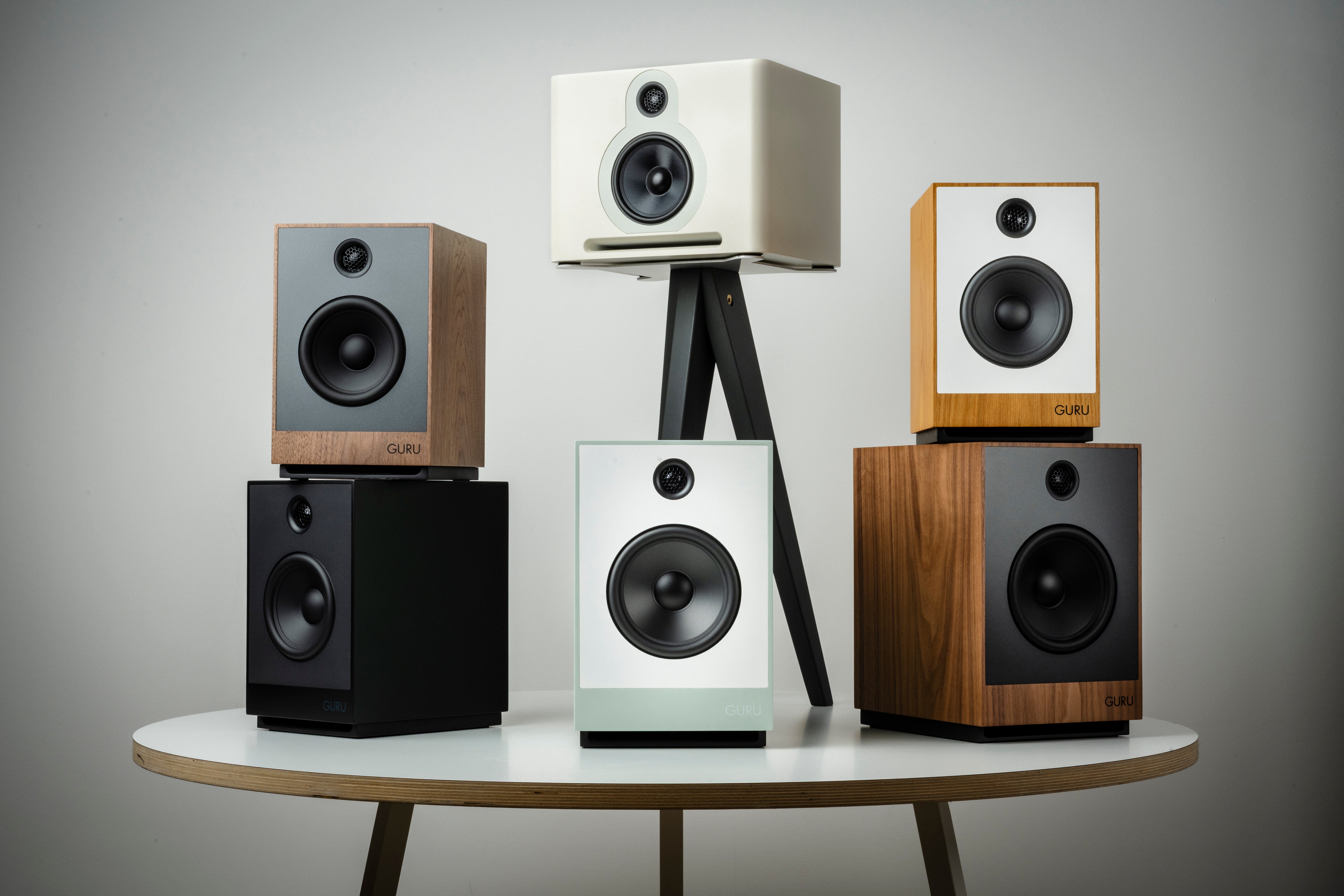
A distillation of the Ino-Lab project, a profile of its three hosts drawn from their published work (translated from Swedish where necessary), an extension of their ideas as an alternative perspective on the framework established by Floyd Toole and developed at Harman International — and the connection to the Guru loudspeaker design philosophy.
Cole's Notes: The Two-Minute Version
For readers who want the whole theory in two minutes:
- What Ino-Lab is. A Swedish audio-education project (podcasts, videos, articles) born when a two-part Swedish National Radio series on lossy compression and the Loudness War drew an overwhelming listener response. Motto: audio knowledge "based on science and sense."
- Who's behind it. Radio producer Anders Olsén (Swedish National Radio since 1983); Lars Mossberg, veteran Sveriges Radio research engineer, co-author of a peer-reviewed study showing DAB+ digital radio needs ~192 kbit/s or more to avoid degraded sound; and Ingvar Öhman — former psychoacoustics researcher, chairman of Sweden's Audio-Technical Society, R&D lead for Carlsson, and the designer behind Guru Loudspeakers and Ino Audio.
- The mainstream view they're read against. Toole/Harman: measure the speaker anechoically ("spinorama"), aim for flat smooth response and even directivity, treat the room statistically, manage bass with placement/subs/EQ — a framework validated by large blind preference tests.
- Where everyone agrees (don't debate these). Blind testing beats anecdote; frequency response is the #1 variable; boundary bass physics; loudness normalization; cable mysticism.
- Where they genuinely differ. (1) The room: Öhman's school designs the speaker for a specified placement — the wall is a component, not a nuisance. (2) Early reflections: not "benign on average" but individually engineered — damp some, keep others. (3) Dynamics and nonlinear distortion: the axis Harman's preference model barely weights is Öhman's primary design vocabulary (avalanche distortion, overshoot distortion, FM/Doppler modulation). (4) Phase linearity: possibly inaudible — but a research monitor must exceed the threshold under study, or the question can never be tested.
- The Guru connection. Guru's current line — Guru 8, 12, 20, 28, 42 and the flagship Q10, successor to the cult QM10, which is discontinued along with the QM60 — is the philosophy in commercial form: a 2007 three-way founding between Öhman, violinist Erik Ring and industrial designer Erik Espmark, today developed in partnership with the Pro-Ject group with European manufacturing. The result: squat wide cabinets whose official manual specifies placement "very close to a solid wall — ideally less than 5 cm," crossovers that shape dispersion so the boxes "disappear," foam decoupling instead of spikes, spec sheets that quote in-room response — and setup guides that prescribe the room. Advantage: deep, predictable bass from a small box in the position real living rooms actually allow. The honest flip side: such a speaker looks wrong on an anechoic bench — the paradigm disagreement in one picture.
- Bottom line. This is not objectivists vs. believers — it's a family argument inside scientific audio about tolerances, weightings, and whether "the average room" is a useful design target. Posed properly, it's a research agenda, not an attack on anyone so stay calm and carry on. Take a listen for yourself.
How to read the citations. Every substantive claim carries a bracketed source number keyed to the reference list at the end, tagged by evidence tier: (P) primary — the hosts' own words or publications; (S) secondary — reviews, wikis, press, forum reports by others; (I) inference — the compiler's synthesis, explicitly labeled. Nothing marked (I) should be quoted as the hosts' documented position. Appendix A provides annotated source excerpts (translated where necessary) for the load-bearing claims.
Part 1 — What Ino-Lab actually is
Ino-Lab presents itself as an audio knowledge base "based on science and sense," built around educational podcasts, videos, articles and links for producers, engineers and serious listeners [1](P). The project grew out of a two-part mini-series, What's that sound?, broadcast on Swedish National Radio — one episode on lossy compression, one on the Loudness War. Listener response was strongly positive, with repeated requests for more material and for an internationally available English version; Ino-Lab is the answer to those requests [1](P).
The founding complaint: the music- and sound-production world, despite good intentions, behaves like the fashion and lifestyle industries — trend-driven, commercially pressured, and short on knowledge grounded in scientific research, neurological studies and physics. The founders' stated ambition is to deconstruct audio scientifically, down to what they call a molecular level, beginning with five podcasts supported by text, video and listener Q&A, and eventually to gather reliable audio knowledge in one place, since no such "bible" or "wiki" exists [1](P).
Their framing questions: How do you achieve a transparent, linear production chain? Can a compressor work without adding unwanted FM-modulation? What does a producer, engineer or listener need to know to be free to make their own choices? [1](P)
Current content:
- Podcast (English and Swedish). Episode 1 defines the problems affecting virtually the entire audio world. Every episode is delivered at −23 LUFS per EBU R 128 — the podcast practices the loudness-normalization position it argues [1](P).
- Video — "Ingvars hörna" (Ingvar's Corner, Swedish). Deep-dive clips complementing the podcasts, mostly led by Ingvar Öhman; episode 1 covers loudness-measurement standards, with a teaser on överslängsdistorsion ("overshoot distortion") [1](P). The English video page reads "coming soon."
- The Basics. An ear-training page linking the same musical idea at different quality levels on Spotify and Tidal, with the honest footnote that a likable tune that sounds bad beats high-quality material you don't like — the point is to have both [1](P).
- The Origin. The two original Swedish Radio broadcasts, to be published with subtitles — "subtitled radio" [1](P).
A signature quote from Öhman anchors the first podcast: "to be free to create, one must first have experienced how amazing it can sound" [1](P).
Credits
| Person | Role at Ino-Lab | Background |
|---|---|---|
| Anders Olsén | Host, producer, instigator | Radio journalist, producer, sound engineer, lecturer 30+ years; independent producer for Swedish National Radio since 1983 (ogjort.com) [1](P) |
| Lars "Mossan" Mossberg | Expert — broadcast & distribution | Development/research engineer at Swedish National Broadcasting; EBU sound research member [1](P), [7](S) |
| Ingvar Öhman | Expert — psychoacoustics, acoustics, loudspeakers | Former psychoacoustics researcher; chairman of Ljudtekniska Sällskapet; designer for Ino Audio, Guru, and Carlsson R&D [1](P), [13](P) |
Part 2 — The hosts, through their own published work
2.1 Anders Olsén — the journalist
Olsén has recorded rock bands in Stockholm's suburbs since the 1970s and produced for Swedish National Radio since 1983. His self-description: a career spent searching for hard facts in sound engineering, and delight at the rare experts who can present them [1](P). Structurally he is Ino-Lab's interlocutor — the one who makes the two engineers explain things a listener can absorb.
2.2 Lars Mossberg — the broadcast engineer
Mossberg spent over four decades at Sveriges Radio, from sound engineer in the early 1970s to technology development [7](S). Three threads:
The FM chain. Ino-Lab describes him as the man behind the world's best-sounding FM distribution chain — note that this is the project's own characterization of a colleague, not an independent ranking [1](P). Independently documented: in a 2013 Monitor interview he explains why Sweden's FM network, co-built with the TV network in the 1950s–60s, is unusually well-constructed and worth keeping [7](S/P — his words, reported).
The DAB scrutiny. Ino-Lab credits him with spotting low-level deficiencies in the first DAB system, sending it back for rework [1](P — the project's account). Corroborating his standing: Mossberg co-authored a peer-reviewed Journal of the Audio Engineering Society study (with Luleå University of Technology and Sveriges Radio colleagues) concluding DAB+ requires roughly 192 kbit/s or more to avoid degraded audio quality — a finding submitted into the UK's FM switch-off consultation [8](S, summarizing the JAES paper).
Loudness normalization. In the Monitor interview he describes the Loudness War and points to the EBU/ITU loudness standards as the corrective, citing broadcasters whose complaints ceased after adoption [7](S/P). After retirement he publicly proposed that Sveriges Radio stream an unprocessed, full-dynamics feed of the classical channel P2 [9](P). Ino-Lab's −23 LUFS mastering policy is this worldview made audible [1](P).
2.3 Ingvar Öhman — the psychoacoustician-designer
From Swedish print interviews — principally the long-form, 20-chapter "A 'little' interview with Engineer Öhman," archived at faktiskt.io [10](P) — and Swedish hi-fi press [11,12](S):
- Origin. A cellist, hobby composer and physicist, Öhman co-founded a private hearing-research institute, Audio Púrus ix, in 1977, after a conversation with a physician about a gap: academic hearing research addressed hearing damage, while no one was researching the ear's properties with respect to music reproduction [12](P — his account, reported in press), [11](S).
- The monitor came first. The study stalled because no available loudspeaker was accurate enough for controlled hearing experiments — his own three-way builds had phase distortion that made studies of phase-detection ability impossible. The first year went into designing a research source: wide bandwidth, high phase linearity across horizontal radiation angles, and the ability to take 100 W without what he terms avalanche distortion (lavindistorsion). Completed January 1978, it became the "audiology monitor" Ino Audio pi60 [12](P, reported), [11](S).
- Eleven years of psychoacoustic research followed, on how and why we hear as we do [1](P), [11](S). (See Part 7 on the publication status of this work.)
- Roles. Chairman of Ljudtekniska Sällskapet (LTS) and responsible publisher/technical editor of its magazine Musik & Ljudteknik [10](P). His long-running forum signature, translated: former psychoacoustics researcher and LTS chairman; now an acoustician specializing in studio control rooms, home cinemas and listening rooms; chief R&D for Carlsson and Guru; consultant; hobby speaker manufacture (Ino) [13](P).
- The Carlsson connection. Friend of and ultimately R&D lead for Stig Carlsson, designer of the Sonab/Carlsson "ortho-acoustic" speakers built to use the room's early reflections. Öhman designed the OA58 and the ".3" tweeter upgrades, and has said in Swedish media that Carlsson's engineering was far more rigorous than his marketing image suggested [22](P — his words, reported), [15](S).
- Commercial work. The Guru near-wall monitors (the company co-founded in 2007 with professional violinist Erik Ring — who had spent the prior year supplying Ino Audio kits to orchestra colleagues — and industrial designer Erik Espmark [32](P), [36](S)) — historically the QM-10, QM10two and QM60 [18,19,26b](S), today the Guru 8/12/20/28/42 range and the Q10, the QM10's direct successor [26,31](P — manufacturer); Ino Audio's pi/i-series and Profundus bass modules [11,17](S); a Hypex-based amplifier (bpa80V-2-2) with modules modified to his specification [21](S). The Swedish hi-fi wiki summarizes the company's stated pillars as neutrality, phase linearity, controlled dispersion, and a whole-system approach in which speaker, amplification and room acoustics are engineered together, with Swedish professional studios using Ino systems as references [20](S — sympathetic source; treat as the company's self-description echoed).
Part 3 — The consensus position, stated fairly
The mainstream framework, from Floyd Toole's NRC and Harman research and Sean Olive's preference modeling [23,24,25]. Stated in its strong form — the version its authors would recognize:
- Anechoic data predicts preference. The "spinorama" (CTA-2034) curve family statistically predicts listener preference in controlled double-blind tests [23,24,25].
- The winning profile: smooth, flat on-axis and listening-window response; smoothly varying directivity so reflected sound resembles the direct sound; extended low bass. Olive's models weight response smoothness and bass extension most heavily [24].
- Early lateral reflections in ordinary rooms are typically benign and often preferred, adding spaciousness; listeners substantially adapt to their room [23].
- Above the room's transition frequency, the speaker's anechoic behavior dominates perception; below it, room modes are managed with placement, multiple subwoofers and equalization. Toole cautions against broadband room EQ based on a single microphone curve [23].
- Nonlinear distortion rarely differentiated competently engineered speakers in the preference tests — with the explicit acknowledgment, in Toole's own writing, that distortion research is incomplete rather than closed [23].
- No compelling evidence that phase response is audible with music in reflective rooms [23].
- Good speakers are placement-tolerant by design; boundary effects are real physics to be managed, not designed around a single prescribed position [23].
This framework is validated by controlled preference testing at scale. Any alternative worth reading must engage it on methods — and the Swedish current mostly does.
Part 4 — Six fault lines, each labeled
Crucially, this is not a subjectivist rebellion. Öhman is a self-described objectivist [10](P) who has publicly calculated that speaker-cable level differences amount to hundredths of a dB and warned blind-testers against "compensating" for them [16](P — his words, reposted). He and Toole stand on the same side of the science/faith divide; the disagreement concerns weightings, tolerances, and the status of the room. Each fault line states the common ground first.
4.1 The room: managed variable, or design component?
Common ground (not debatable): boundary reinforcement of bass, comb-filter interference from nearby surfaces, and floor/ceiling reflections are settled physics both camps calculate the same way [13](P), [23]. Toole also acknowledges that real speakers often end up near walls.
Genuinely contested: what to do about it. The consensus designs the speaker anechoically for placement tolerance in a statistically typical room [23]. The Carlsson/Öhman tradition designs for a specified placement, treating the boundary as a component: Carlsson's ortho-acoustic models were engineered for the wall [15](S), [22](S); the Guru range is designed for near-wall use with boundary gain in its bass alignment and a stated placement window [18,19,26](S/P); Öhman writes that a corner-placed speaker must be analyzed with the corner as part of the speaker, raising direct-sound ratio, efficiency and maximum bass output [10 ch.13](P).
The alternative's claim, fairly put: fixing placement converts the two largest uncontrolled variables in the spinorama paradigm — boundary distance and early-reflection geometry — into design constants. It trades universality for precision in one specified setup. (Framing is the compiler's — I.)
4.2 Early reflections: benign on average, or individually engineerable?
Common ground: reflections exist in every room; their audibility depends on level, delay, direction and spectrum; some add pleasant spaciousness [13](P), [23].
Genuinely contested — a matter of degree, not kind: the consensus concludes untreated lateral reflections do not, on average, harm preference [23]. Öhman's published analysis is more granular: a wall behind a speaker comb-filters at any distance (spacing changes comb density and amplitude, not existence), and psychoacoustically a reflection's arrival time matters less for detection than for whether its effect lands as destructive, neutral or constructive — which further depends on the number of reflections and their directions [13](P; see Appendix A.3). The associated room prescriptions in the Carlsson/Öhman lineage — damp the floor mirror-point, keep the ceiling reflective, diffuse the side walls, balance bass tuning against calculated boundary gain, aim for a psychoacoustically correct curve in specific directions rather than a flat anechoic axis — classify reflections and treat each class differently [14](P/S), [15](S). Forum discussion among Carlsson specialists records that Öhman favors fewer room reflections than Carlsson himself did [15](S).
Status: an expansion more than a contradiction. The consensus states what holds on average across rooms; the Swedish position claims a designer who prescribes the room can beat the average — particularly for monitoring, where added spaciousness is a colorant. That stronger claim has not been tested at Harman scale, and both sides could agree on the experiment that would settle it. (I)
4.3 Frequency response tolerances
Common ground (not debatable): both camps rank frequency response as the dominant variable [10](P), [23,24]. Toole's research itself established that trained listeners detect certain resonances at fractions of a dB, so "small deviations can matter" is not foreign to the consensus [23].
Contested, and flagged as inference: the compiler's reading — from Öhman's habit of quantifying hundredth-of-a-dB effects even when dismissing them [16](P), from single-dB midrange contours treated as decisive character differences in his driver-substitution engineering notes [S — CarlssonPlanet newsletters], and from the pi60's founding premise that commercial monitors were outside research tolerance [11,12] — is that Öhman operates with materially tighter working tolerances, over longer listening terms, than typical preference-test resolution. This is a synthesis (I), not a documented head-to-head claim by Öhman against the Harman tolerance windows. The testable form: do small spectral errors that survive short A/B preference tests matter over long-term and professional use? Ino-Lab's stated program is suited to exactly this question [1](P).
4.4 Dynamics and nonlinear behavior
Common ground: the consensus does not claim distortion is inaudible — it reports that distortion rarely decided its preference tests among competent designs, and explicitly labels the area under-researched [23]. There is no dispute that drivers compress, that large excursions FM-modulate the midrange, or that clipping-adjacent behavior is audible.
The genuine gap the alternative fills: where the preference model barely weights nonlinearity [24], it is Öhman's primary design vocabulary: avalanche distortion as a spec limit for the pi60 [12](P, reported); overshoot distortion as an Ino-Lab teaching topic [1](P); FM-modulation posed as a chain-wide question in the project's introduction [1](P); dynamics-first engineering visible in his experimental multi-driver bass systems, including a switchable dipole/omni array built to study bass directivity [10 ch.13](P); even the mechanical interface — he rejects spikes as inducing cabinet stress, distortion and stand/floor resonance, floating speakers on foam feet instead [19](S — designer's rationale, reported). The original QM10's front-baffle LED, which warned when the drivers approached the overload region rather than indicating clipping, was the same thinking as a user-interface feature [19,29](S — historical model).
Fairly put: level-matched preference tests at moderate volume structurally cannot expose behaviors that appear only at realistic peaks and over program time; a ranking without a dynamics axis is incomplete on that axis. This is an argument several professional-monitor makers share, and one the consensus's own "incomplete research" caveat leaves open. (Framing I; premises P/S as cited.)
4.5 Phase linearity
Common ground / where the consensus currently holds: controlled evidence for phase audibility with music in reflective rooms remains weak, and this document does not claim otherwise [23].
The methodological point that stands regardless: Öhman built the pi60 phase-linear across horizontal angles because an instrument dirtier than the threshold under study cannot investigate that threshold [12](P, reported). A research monitor must exceed hypothesized human sensitivity even in dimensions the current model deems irrelevant — otherwise the model cannot be falsified. This is an expansion of research methodology, not a contradiction of Toole's audibility finding. (Framing I.)
4.6 System versus component
Not a scientific dispute at all — a difference in product philosophy, and it should not be presented as a refutation of anyone. The consensus framework scores the loudspeaker as a product; it says nothing against system engineering. Ino Audio simply operates the other way: tops matched to bass modules, amplification designed for the load, room-acoustics consultation bundled with the purchase [17,20,21](S). Ino-Lab generalizes the same instinct to the whole production chain — transparency from microphone through compressors, codecs and distribution loudness to monitor and room [1](P); the Loudness War and lossy-compression episodes are the broadcast-chain version of the argument [1](P), [7,8](S).
The agreements, gathered in one place
Blind testing over anecdote; measurement over marketing; loudness normalization (EBU R 128); rejection of cable and accessory mysticism [16](P); frequency response as the first-order variable; boundary-bass physics; the reality of listener adaptation; and controlled experiment as the arbiter. Every fault line above sits inside that shared frame. The open question both sides could endorse: has three decades of preference research measured everything perceptually important, or everything measurable at scale so far? Posed that way, it is a research agenda, not an accusation. (I)
Part 5 — The Guru connection: the philosophy as a product
If Parts 3–4 are abstract, Guru Loudspeakers is the concrete exhibit — the clearest commercial embodiment of the Öhman design philosophy, and the reason his name traveled outside Sweden. The current range comprises the Guru 8, 12, 20, 28 and 42 plus the flagship standmount Q10; the models that built the reputation — the QM10, QM10two and QM60 (QM for Quality Manager, signaling the monitoring intent [18](S)) — are discontinued, with the Q10 as the QM10's direct successor: same 300×232×252 mm wide-format cabinet, same 102 mm mineral-fibre mid/woofer concept and 2–7 kHz crossover band, still introduced as "originally designed for professional use" [31](P). Reviews and measurements of the QM models below are cited as historical evidence for the design philosophy, not as endorsements of products one can buy — anyone shopping today is looking at the current range.
Guru Audio itself is a three-legged founding (2007): acoustic engineer Ingvar Öhman, professional violinist Erik Ring, and industrial designer Erik Espmark [32](P — manufacturer). The division of labor maps directly onto the design philosophy this article describes. Öhman supplies the psychoacoustics and engineering; Ring's ear as a working musician informs the voicing priorities — natural tonal balance, timing, dynamics, emotional realism — that Part 4 identifies as the school's distinctive axis; and Espmark, trained at Konstfack, brings the Scandinavian design perspective that treats a loudspeaker as furniture meant to belong naturally in the home [32](P). This division of labor was visible from the first QM10, whose cabinet was shaped by Espmark in close collaboration with Öhman [36](S), and was stated plainly by Ring in a 2012 press profile: the company doesn't compromise on sound, yet half its buyers choose the speakers for their looks [34](S — his words, reported, translated). Announcing the flagship Apex series in 2026, Ring and Espmark jointly described their philosophy as design and musicality in their purest forms — speakers that must work in ordinary home rooms, playing with the room rather than against it, near-wall placement recommended as ever [35](S — joint statement, reported, translated). Today the trio continues development in Stockholm in partnership with the Pro-Ject group, with manufacturing in Europe [33,36](S).
What the design actually does
- Placement is a specification, not a suggestion. Guru's current official user guide (covering Guru 8, Guru 12 and Q10) states the standmounts are "designed to be placed very close to a solid wall" — ideally under 5 cm — with damping material indicated behind the speaker, ~57 cm stands, the tweeter at or below ear height, toe-in adjusted until the outer side edges are just visible, and a listening-distance diagram of ~1.2× the speaker spacing [26](P — manufacturer documentation). Its room-adjustment page is the Carlsson-school prescription in spirit: rugs (the more the better), soft furnishings, flat wall surfaces broken up with shelves and pictures, and a low coffee table to reduce floor reflections [26](P), [14](P/S). Historically, the larger QM60's documentation specified 40–70 cm from tweeter to rear wall, toed in, with a crossover described as countering the detrimental effects of wall reflections [26b](S); the Hi-Fi+ QM10two review reported the same family of unusually specific setup notes [19](S).
- Even the spec sheet speaks the paradigm. Guru's official specifications list "typical in-room response" (e.g., 30 Hz–30 kHz for the Q10) rather than an anechoic figure — the disagreement about measurement context, printed on the data sheet [26,31](P).
- Boundary gain is in the bass alignment. Reviewers measured in-room output from the tiny 4-inch-woofer, ~12-litre QM10 (2008, discontinued) down to roughly 25 Hz — bass extension "remarkable for such a small loudspeaker" being the consistent observation, achievable because the wall the consensus treats as a variable is here a constant the tuning assumes [18](S), [30](S); Guru markets the principle outright as "bass without the boom" [26](P). Öhman has also attributed the bandwidth-per-size to an unusually high-pressure-factor woofer of his design [29](S — his correspondence, quoted by owner).
- Directivity is used psychoacoustically, not just smoothed. In his own English-language forum post (about the original QM10; the approach carries into the Q10's identical crossover band), Öhman explains that the crossover deliberately controls vertical dispersion, modulating timbre with height "to make the speakers disappear as sounding object in the soundstage," including for listeners at different heights — and he candidly notes where the trick falls short of the ideal 800 Hz–7 kHz range and why hearing forgives it [27](P). This is a designer reasoning from perception backwards to the measurement, where the consensus reasons from the measurement forward.
- The philosophy is on the current product page. The Q10 is presented with an explicitly anti-euphonic credo — "a colouration remains a colouration, however attractive it may be" — and reproduction framed as adapting to the listening room's properties with respect to hearing, with a claimed woofer pressure factor exceeding a typical 15-inch driver's by more than three times [31](P — manufacturer claims, so promotional in nature but primary as to philosophy).
- The shape serves the physics. Wider than it is tall, the squat cabinet distributes internal standing-wave modes and serves dispersion control [18](S).
- Mechanical decoupling instead of spikes, for the cabinet-stress and floor-resonance reasons given above [19](S).
The advantages of this approach
- Real-world bass economics. Boundary loading is free acoustic gain: a small, domestically acceptable box produces bass depth and efficiency that the same box could never produce in free space — documented on the historical QM10 [18,30](S) and specified for the current line [26](P).
- Predictability. Because placement is specified, the in-room response the designer voiced is approximately the response the owner gets — the single biggest source of speaker-to-speaker variation in homes (position) is removed by instruction rather than left to chance. (I, from [19,26])
- Domestic compatibility. Speakers that belong against the wall end up where furniture, spouses and floor plans put speakers anyway — the design meets reality instead of fighting it. And per the founding above, this is Espmark's explicit design thesis rather than a side effect [18](S), [32](P).
- Comb-filter management by proximity. Öhman's own analysis: the rear-wall interference never disappears with distance, but close placement pushes the comb structure into a sparser, higher-frequency, more benign pattern than the mid-distance placements common in free-standing setups [13](P).
- A worked example of reflection engineering. The bundled room prescription (damped floor path, coffee table at the mirror point, damping elsewhere) demonstrates the classify-and-treat approach to reflections at consumer scale. [26](P), [14](P/S)
The honest counterpoint — and why it's instructive
Bench measurements of the original QM10 — a 2008 model, long discontinued and superseded by the Q10 — published by mainstream outlets showed an uneven anechoic-style response (mid-bass emphasis, lean upper bass/lower mid, ~1 kHz peak) and unremarkable distortion figures versus conventional competitors [18](S), [28](S). Under the spinorama paradigm, that read as a flawed speaker; no equivalent third-party bench data on the current Q10 is cited here. Under the design-for-placement paradigm, a speaker voiced for a wall should look wrong measured without one — the boundary and prescribed room are part of the transfer function being voiced. Which reading is correct is not settled by either camp's rhetoric; it would be settled by controlled in-situ listening tests at the specified placement. That unresolved measurement-context question is the entire Toole/Öhman disagreement compressed into one product line — and it is why Guru is the right case study for this article. (I, from [18,26,28])
Part 6 — What Ino-Lab adds going forward
Ino-Lab is the pedagogical arm of this worldview: chain-level thinking (microphone to room), loudness sanity, codec literacy, and — via Ingvar's Corner — the dynamics/distortion vocabulary (overshoot distortion first) that the preference-testing literature has left under-weighted [1](P). Its stated method, controlled and science-based, is the same method that would be needed to test its own school's stronger claims. That symmetry is the healthiest thing about it. (I)
Part 7 — Caveats a scrutinizing reader will (rightly) raise
- Publication asymmetry. Toole's and Olive's claims live in peer-reviewed AES literature and an ANSI/CTA standard [23,24,25]. Öhman's eleven years of psychoacoustics live mostly in his designs, Swedish magazine writing, interviews and forum posts [10–16]. His positions are presented here as serious hypotheses from a qualified practitioner — not as an equivalent evidence base.
- Evidence tiers are mixed by necessity. Several biographical and technical claims come from Swedish press profiles and enthusiast archives [11,12,17]; they are tiered (S) accordingly, and Appendix A shows exactly what each source says.
- Scale. Harman's data covers hundreds of listeners and speakers; the Swedish school's base is small-N and expert-listener. Each method is blind to what the other sees.
- Interests. Harman sells products validated by its own metric; Öhman designs products embodying his philosophy. Symmetric, and dispositive of nothing.
- Ino-Lab is young. One English episode plus scaffolding exists; the five-episode program and knowledge base are stated ambitions [1](P). This article extends the hosts' prior work; the podcast itself may weight things differently.
- Ring and Espmark on the record. Everything from Guru's two non-engineer founders is press-reported or promotional [32,34,35]; neither has published primary written work of his own, so their positions carry the same "serious statements from qualified practitioners, not an evidence base" framing applied to the softer Öhman sources.
Appendix A — Annotated source excerpts (load-bearing claims)
Direct archive access to faktiskt.io is bot-restricted; excerpts below were captured via search indexing of the archived pages and are paraphrased in translation, with at most one brief verbatim quotation per source. Anyone auditing this document can verify each item at the cited URL.
A.1 — Öhman's credentials, in his own signature [13].
Every post in the 2015 faktiskt.io thread "Högtalare emot vägg" carries Öhman's signature, which translates as: former psychoacoustics researcher and LTS chairman; now an acoustician specializing in studio control rooms, home cinemas and music-listening rooms; also chief R&D for Carlsson and Guru, consultant to others, plus hobby loudspeaker manufacture (Ino). (Primary; self-description.)
A.2 — The founding of the research and the pi60 [12].
The scanned Swedish press profile (user.faktiskt.io/audix/hifi/ingvar/page5.pdf) reports Öhman's account: a 1977 conversation with a physician about the oddity that academic hearing research concerned hearing damage while no one researched the ear's properties for music reproduction; the founding of Audio Púrus ix; and the realization that his own three-ways were unusable because, in translation, "their phase distortion made studies of our phase-detection ability impossible." The design goal for the replacement is described as a wide-bandwidth source with high phase linearity in all horizontal radiation angles, handling 100 W without avalanche distortion (lavindistorsion). (Primary account, reported in press.)
A.3 — Wall reflections: combs and constructive/destructive weighting [13].
In the same 2015 thread, Öhman writes (paraphrased in translation): you get comb-filter effects from the wall behind the speakers whether the distance is one metre or one decimetre — the difference is not that they vanish, but that the combs come much closer together at larger distances, typically with smaller amplitude. Psychoacoustically it is more complicated: one must weigh the ear's time-dependent weighting; for detection, a reflection's arrival time matters relatively little, but for whether its influence is experienced as destructive, neutral or even constructive, time becomes decidedly important — and even that is a strong simplification, since both perception and the character of the effect depend heavily on the number of reflections and their arrival directions. (Primary.)
A.4 — The corner as part of the loudspeaker; the dual-directivity bass experiment [10, ch. 13].
In chapter 13 of the long interview ("Ljudutstrålning från högtalare"), Öhman states that at low frequencies normal speakers are omnidirectional in free placement, but a speaker placed near a room corner must be analyzed with, in translation, "the corner counted as part of the loudspeaker," which increases the direct-sound proportion, efficiency, and maximum bass capability. He then describes building, ~14 years earlier, a combined bass system — a four-by-12-inch dipole plus a fully omnidirectional sealed 12-inch, separately amplified and filtered — so the combination could realize any directivity characteristic, with different dispersion at different frequencies, in order to form an evidence-based view on bass radiation. (Primary.)
A.5 — The Carlsson-school room prescription, with Öhman's annotation [14].
The faktiskt.io thread "Möblera för bästa återgivning med Carlssonhögtalare" preserves the Carlsson placement guidance: both speakers against the same (preferably long) wall, wide apart but ≥40 cm from corners to avoid fatiguing bass lift; the floor between speakers and listener damped (thick rug; a coffee table ideally covering the listener's "mirror image" of the speakers); the room damped below ear level; the ceiling left reflective; bookshelves as side-wall diffusion. Öhman's own comment in the thread refines it model-by-model — advising against the coffee table for the low OA50/OA52 because their design depends on the floor reflection in the 200–500 Hz region, while endorsing it for all older Sonab models, the OA51, and "coming models." (Guidance text secondary; Öhman's annotation primary.)
A.6 — "Psychoacoustically right, in specific directions" [15].
In the thread "Ortoakustiska principen — förbättringsbar?", a Carlsson-specialist contributor summarizes the school's design goals — controlled, even dispersion across the range; minimizing destructive and maximizing constructive reflections; bass tuning balanced against calculated boundary gain; low-distortion drivers in their working ranges — capped by the formulation, in translation, "not necessarily a flat tonal curve, but a psychoacoustically right tonal curve in specific directions." The same thread records the understanding that Carlsson wanted more room reflections for atmosphere than Öhman does. (Secondary — community summary, valuable as the school's articulation; the Carlsson/Öhman difference is the thread's report, not Öhman's own post.)
A.7 — The cable calculation (the objectivist credential) [16].
A 2013 forum thread reposts Öhman's analysis of a proposed speaker-cable blind test: a 4 m, 2.5 mm² cable has ~0.055 Ω resistance; into a speaker whose impedance swings from 5.6 Ω upward, the level falls by 0–0.085 dB depending on frequency, i.e. a response ripple of ±0.0425 dB versus an idealized zero-length cable — differences between real cables being far smaller still; he concludes level "compensation" in such tests is meaningless-to-harmful. (Primary, reposted.)
A.8 — The perception-first crossover (original QM10), in Öhman's own English [27].
In the 2009 AVS Forum thread, Öhman explains that the QM10 crossover also controls vertical dispersion, modulating timbre with listening height "to make the speakers disappear as sounding object in the soundstage" — including for multi-row seating — and notes the ideal range for the trick would be 800 Hz–7 kHz, which the small tweeter cannot fully cover, but that dominant higher-frequency cues psychoacoustically outweigh the missing 800–2000 Hz height modulation. (Primary; his post, in English.)
A.9 — Guru placement specification, from the official manual [26]; setup notes and decoupling rationale [19].
Guru's current "User Guide for Guru 8, Guru 12 and Guru Q10," downloaded from the manufacturer's manuals page (July 2026), states the standmount speakers are "designed to be placed very close to a solid wall" — ideally less than 5 cm — and its diagrams indicate damping material behind the speaker, ~57 cm stand height, tweeter no higher than ear level, toe-in until the outer side edges are just visible from the listening position, and a listening distance of ~1.2× the speaker spacing. Its room-adjustment list: rugs to reduce reverberation, soft furnishings, breaking up flat wall surfaces with shelves and pictures, and a low coffee table to reduce floor reflections. The specification tables give "typical in-room response" figures rather than anechoic ones. (Primary — manufacturer documentation.) Historically, dealer documentation for the QM60 specified 40–70 cm tweeter-to-rear-wall, toed in, with a crossover described as countering wall-reflection effects [26b] (secondary). The Hi-Fi+ issue-89 QM10two review reports the same family of setup notes and the designer's rationale for foam-foot decoupling: spikes introduce mechanical tension into the cabinet, causing distortion and inducing resonance in stand and floor [19] (secondary).
A.10 — The measurement counterpoint (historical QM10, discontinued) [18, 28].
TechRadar's QM10 review measured an uneven balance (mid-bass emphasis 40–60 Hz, leanness 80–300 Hz, ~1 kHz peak) alongside in-room bass output to ~25 Hz from the 12-litre box [18]. SoundStage-published THD+N and response curves, circulated critically in the AVS thread, showed the QM10 unremarkable against conventional competitors on the anechoic-style bench [28]. Included deliberately: this is the strongest evidence against the design school under consensus metrics, and the clearest illustration that the two camps disagree about the measurement context itself. (Secondary.)
A.11 — The founding trio and their stated philosophy [32, 34, 35, 36].
Guru's official "About" page names the 2007 founders — professional violinist Erik Ring, industrial designer Erik Espmark (Konstfack) and acoustic engineer Ingvar Öhman — and describes their complementary expertises: Ring's musician's understanding of how real instruments sound and behave in space, shaping a philosophy of natural tonal balance, timing, dynamics and emotional realism; Espmark's Scandinavian design perspective treating loudspeakers as furniture meant to belong naturally in the home [32] (primary — manufacturer self-description). A 2012 Uppsala newspaper profile quotes Ring (translated): the company doesn't compromise on sound, yet half its buyers choose the speakers for their looks; it also notes his role as a working violist [34] (secondary — his words, reported). Announcing the Apex flagship series in 2026, Ring and Espmark are jointly quoted describing the series as the fullest expression of their philosophy — combining design and musicality in their purest forms — with the accompanying report stressing that the speakers must work in ordinary home rooms, playing with the room rather than against it, near-wall placement recommended as always [35] (secondary — joint statement, reported, translated). A 2026 review records Ring's founding account — a year spent supplying Ino Audio kits to orchestra colleagues before starting Guru in 2007 — and the current arrangement: development by the founding trio, manufacturing in Europe in partnership with the Pro-Ject group [36] (secondary); a QM10-launch-era forum post corroborates that the original cabinet was shaped by Espmark in close collaboration with the engineer [36] (secondary — forum, name misspelled "Aspmark" in source).
References
[1] Ino-Lab project pages (ino-lab.com): Home, Introduction, The Basics, The Origin, Podcast ENG, Video SE — accessed July 2026.
[7] "Framtidens Radio — intervju med Lars Mossberg," Monitor (Håkan Lindberg), 2013. docplayer.se/257575; PDF at mikrofonen.se.
[8] "Dagens DAB+ har sämre ljudkvalitet än FM," Public Access Nordic, Nov 2013 — summary of Berg, Bustad, Jonsson, Mossberg, Nyberg, Journal of the Audio Engineering Society (DAB+ bitrate study).
[9] Sveriges Radio technical-support forum, thread "Hur sänder ni ut P2?" — Mossberg ("Mossan") proposal for an unprocessed P2 stream.
[10] "En 'liten' intervju med Ingenjör Öhman," 20-chapter interview (orig. Sonic Design), archived at user.faktiskt.io/paa/Artiklar/oeint0.html; ch. 13 "Ljudutstrålning från högtalare" (oeint13.html).
[11] "Dagens Högtalare: Ino Audio pi60s," hifinord.blogspot.com, Dec 2009.
[12] Scanned Swedish press profile of Öhman/Audio Púrus ix, user.faktiskt.io/audix/hifi/ingvar/ (page2.pdf, page5.pdf).
[13] faktiskt.io thread "Högtalare emot vägg" (2015) — Öhman on wall reflections; his forum signature.
[14] faktiskt.io thread "Möblera för bästa återgivning med Carlssonhögtalare" — placement/room prescriptions with Öhman's annotations.
[15] faktiskt.io thread "Ortoakustiska principen — förbättringsbar?" — Carlsson design goals; reflection-count difference vs. Carlsson.
[16] Forum för vetenskap och folkbildning (forum.vof.se), speaker-cable blind-test thread (2013), reposting Öhman's level-difference calculation.
[17] AVS Forum, "Interview: GURU designer Ingvar Öhman" (2009), incl. AudiogoN video interview (youtube.com/watch?v=52fFfHHRj5o).
[18] TechRadar, Guru QM10 review, 2008 (historical model).
[19] Hi-Fi+ issue 89, Guru QM10two review (Jason Kennedy) — setup notes; decoupling rationale (historical model).
[20] SweFi — Svensk HiFi-wiki, "Ino Audio."
[21] HifiKit, Ino Audio bpa80V-2-2 product description.
[22] SVT Nyheter, "Retrohögtalarna i ropet igen" (Carlsson feature with Öhman), Mar 2018.
[23] F. E. Toole, Sound Reproduction: The Acoustics and Psychoacoustics of Loudspeakers and Rooms, 3rd ed., Routledge 2017.
[24] S. Olive, AES papers on predicting loudspeaker preference from measurements (2004a/2004b et seq.).
[25] CTA-2034-A, Standard Method of Measurement for In-Home Loudspeakers ("spinorama").
[26] Guru Loudspeakers, "User Guide for Guru 8, Guru 12 and Guru Q10," official manual PDF via guruaudio.com/pages/manuals (accessed July 2026); see also the "Bass without the boom" page.
[26b] Raindrop Audio, Guru QM60 product page (2011) — historical QM60 placement specification (40–70 cm; model discontinued).
[27] AVS Forum thread [17], p.16 — Öhman's English-language post on the QM10 crossover and vertical dispersion.
[28] SoundStage QM10 measurements, as circulated in AVS thread [17], p.3 (historical model).
[29] Hifisentralen.no thread "Guru QM10 — har noen hørt dem?" (2009) — owner correspondence with Öhman (woofer pressure factor; overload LED behavior).
[30] pink fish media, "Guru Audio at Tom Tom" (2008) — Hi-Fi Choice and Stereophile (Art Dudley) show reports on the QM10.
[31] Guru Loudspeakers, Q10 product page (accessed July 2026) — current lineup, Q10 philosophy statement, specifications.
[32] Guru Loudspeakers, "About" page, guruaudio.com/pages/about (accessed July 2026) — founding trio and company self-description.
[33] The Ear, "Guru 8 Speakers: Style and Substance" (Jason Kennedy), 2025 — current development by the founding trio and the Pro-Ject partnership.
[34] UNT (Uppsala), "Högtalare som ger eko utomlands," 2012 — Erik Ring profile and quotes (translated).
[35] Ljud & Bild, "Guru Audio Apex och Elements — två nya serier," June 2026 — joint Ring/Espmark philosophy statement at the Apex launch (translated).
[36] Ljud & Bild, Guru 28 review, April 2026 — Ring's founding account, Ino kit prehistory, European production partnership; and Component.se forum, QM10 launch thread (2008) — Espmark's collaborative design role on the QM10 (name misspelled "Aspmark" in source).
Swedish and Norwegian material translated and paraphrased by the compiler. Claims tagged (I) are the compiler's synthesis. Prepared July 2026 for Audionation.
Guru loudspeakers are designed in Stockholm by their founding team and manufactured in Europe in partnership with the Pro-Ject group.
Audionation is your home for Guru Loudspeakers.
Share:
The Difference Between a Record Player and a Turntable