

Listening Room Confidential, No. 1 — an occasional series.
I've spent too many hours in rooms that smell like carpet shampoo and cologne, standing among men with folded arms, listening to "Keith Don't Go" for the fourth time before lunch. This year the room was in Vienna. Nobody's dancing. Nobody's smiling. A man near the sweet spot is nodding with the grave, slow authority of a bomb technician. Somebody behind me says the word "jitter" out loud, unprompted, to no one. In the corner sit two speakers the size of restaurant refrigerators, finished in a piano black so deep you could shave in it, priced somewhere north of a starter home in a decent school district. The guy who built them is explaining his crossover philosophy to a journalist who stopped listening several years ago.
Rick Rubin was there. I did not expect that, and I got a photo, because of course I did — you don't cross paths with the man and then decline the picture out of some misplaced sense of professional cool. But I keep turning over the geometry of it. The most consequential pair of ears in the building belonged to someone whose entire working method is subtraction: take things away until only the part that matters is left standing. And he was walking through a hall devoted, almost without exception, to addition. More boxes. More cable. More mass. More money.

I love this stuff. That's the whole problem. Nobody gets worked up about things they don't love. You don't write angry letters about paper towel.
And I want to be clear about what this is: an observation, not a complaint. I'm not filing a grievance with management. I'm sitting at the end of the bar with a notebook, watching the place get slowly, cheerfully, expensively weirder.
Up and Up and Up
Because the direction of travel isn't sideways or outward. It's up. Up the price ladder, up the weight class, up into a rarefied air where the customer list gets shorter every year and everybody seems fine with that.
Two hundred grand for a pair of loudspeakers. Interconnects that cost more than the car I drove to the show, arriving in a walnut presentation case with a numbered brass plaque and a pair of white cotton gloves, as though I'd taken delivery of a violin rather than a metre of wire. A power conditioner with a faceplate machined thick enough to stop small-arms fire, bought by a man who will then stream a compressed podcast through it.
None of this is luxury, exactly. Luxury is when the expensive version is genuinely better. Some of this is something else — insecurity with a certificate of authenticity. And nobody in the room particularly wants to discuss the shape of the curve.
The Hole in the Middle
Here's what actually struck me in Vienna, walking High End this year, and it wasn't the two-hundred-grand speakers. It was the gap.
There was affordable. There was eye-wateringly expensive. There was very little in between. You could buy a tidy little system that a normal person might own, or you could buy something that requires a conversation with a wealth manager, and the ground between those two positions — the ground where this entire hobby was built, where a serious person on a normal salary saves up and buys something properly good — had been quietly vacated. Room after room, you'd walk in and find yourself either at the shallow end or in the deep end with no ladder.
What happened to the middle? That used to be the heart of the business. That's where the great arguments happened, where brands made their names, where somebody's first real system came from.
I have a theory, and I don't love it. I think a fair number of manufacturers have looked at their customer base, correctly identified it as older and shrinking, and concluded that the way to survive a shrinking room is to charge the people left in it more money. Price for the man who's paid off his mortgage. Chase the last decade of a generation's spending rather than the first decade of the next one's.
It's rational. It's also a business model with an end date printed on the box, and everyone can read it.
Because the alternative — building something a thirty-year-old with a phone, an apartment and no dedicated listening room actually wants — requires believing that person is worth the trouble. And a lot of this industry seems to have quietly decided they aren't. They stream, you see. They don't care. They'd rather have headphones. All of which is a very comfortable story to tell yourself right up until there's nobody left to sell to.
The Value Equation Nobody Prints on the Box
Here's the arithmetic that governs everything and appears in no advertisement.
From nothing up to about five grand, you're on a rocket. Every dollar buys audible, obvious improvement — the kind your non-audiophile friend notices from the kitchen without being prompted. From five to fifteen, you're still climbing, but paying more per rung. Anything above fifteen and the curve lies down flat like a dog in August, and what you're buying is the last three percent: the veneer, the badge, the machining, the story, the standing.
There's nothing wrong with buying the last three percent. I've paid fifty dollars for a burger in Copenhagen and enjoyed every bite. But a good chunk of this industry has quietly reorganized itself around the idea that the three percent is the hobby, and that everything below it is a compromise you ought to feel faintly embarrassed about. That's a hell of a magic trick — convincing people the appetizer is an insult. Meanwhile the products living on the steep part of the curve, where a thousand dollars still buys you something real, get treated like the kids' menu.
Nobody's Colouring Outside the Lines
Not everything looks the same. But an awful lot of things look the same, and — here's the tell — they tend to look the same at the same price. Walk a show floor and you can guess the sticker from across the room. Fifteen hundred looks like this. Six thousand looks like that. Same rectangular box, same brushed slab with a little OLED window, same matte black, same three finishes, clustered by bracket like school uniforms.
Which tells me nobody's colouring outside the lines. Somewhere in the process a person had an actual idea and got gently talked back off it, because the safest thing to build is the thing that resembles what's already selling in your bracket. Everyone's cooking from the same recipe and calling it a house style.
Then there's the tribe, bless it. Ask an honest question in the wrong forum and within four minutes you'll be answered by a man who hasn't bought a piece of equipment in nine years but will defend his integrated amplifier like it's his daughter's honour at a wedding. Dealers do it too — three brands, one religion, everything else is snake oil. And the reviews? You know how this works. A magazine that eats on ad revenue is going to keep discovering that the year's most thrilling products belong to the year's most enthusiastic advertisers. That's not corruption, it's gravity. It just means the map you've been handed shows only the streets that paid for signage.
And it's getting stranger. Somebody advising me on this very piece suggested I move the brand names up into the opening lines, because that way — and I want you to sit with this phrasing — our entities are now in the first twenty words where they'll actually get indexed. Our entities. Four small companies full of people who solder things, reduced to entities, positioned for the convenience of a machine that will summarize them for a person who never reads the page. That's the game now. Somewhere out there a marketing department is optimizing its entity placement, and somewhere else a man in a workshop in Yorkshire is trying to get a cabinet to stop resonating, and only one of them is going to show up in the answer.
The boutique dealer is probably the way out — the real ones, the converted shopfront with a decent chair, a kettle, and the confidence to put on a record and then shut up. Those shops do the actual work: taking flyers on brands nobody's heard of, letting ears do the deciding. Let's not canonize all of them, though. Plenty carry the same tribal instinct as everyone else, just with a better espresso machine.
Four Arguments in Favour of Thinking
So here's why I keep pointing at the same four names. Each one looked at a crowded room and decided not to stand in the line.
And here's where I hand you the stick to hit me with: all four are our lines. We sell them. Which means somewhere a man is already typing "well of course he likes them, he's got a warehouse full of the things," he'll have it posted within four minutes, and he isn't entirely wrong.
The only defence I've got is that the causation runs the other way round. I didn't start admiring these brands because we took them on. We took them on because I'd been making this exact argument at dinner tables for years and had finally worn out the patience of everyone at the table with nothing to point at. Discount everything below by whatever percentage feels fair to you. I'd suggest ten. My accountant suggests I stop writing pieces like this altogether.
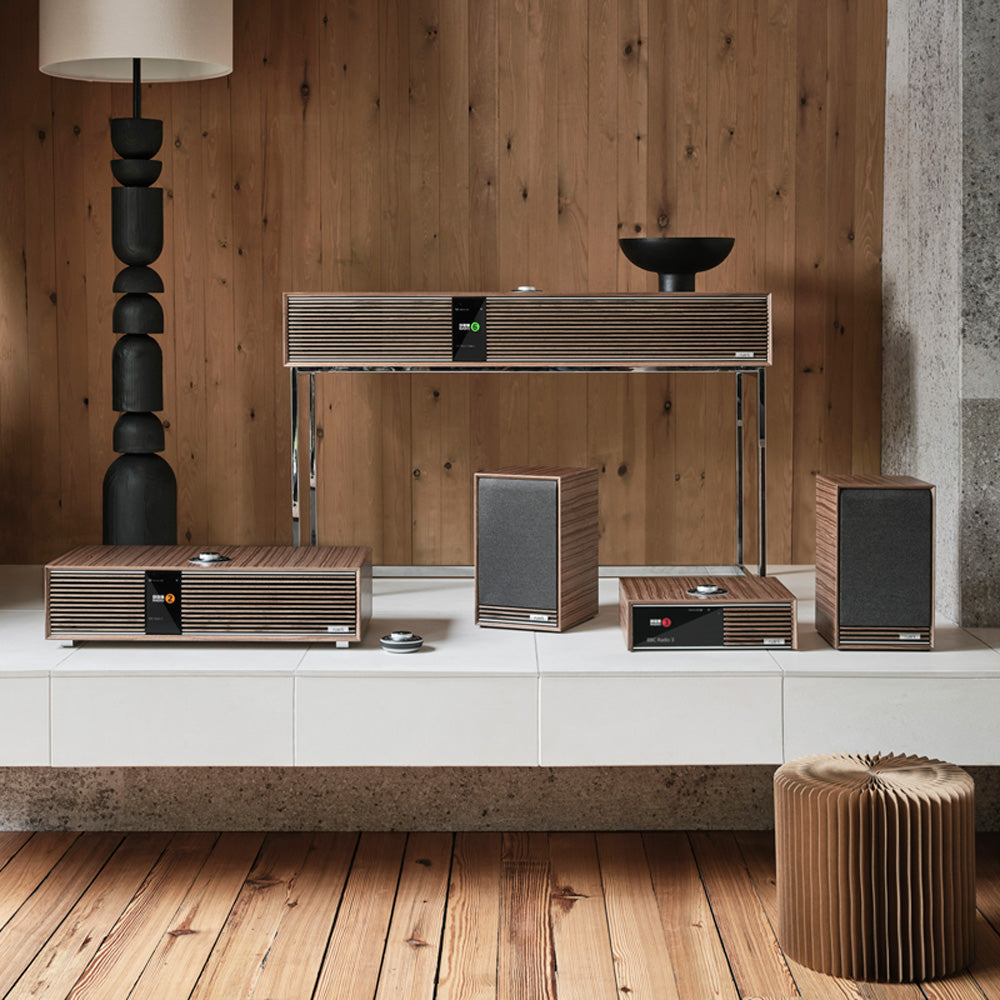
Ruark. The competition is, on one side, a smooth anonymous plastic loaf with an app, and on the other, a luxury all-in-one at two or three times the money doing much the same job with a heavier badge. Ruark built furniture that plays music — walnut, fabric, curves, legs, a volume dial with real weight to it — and then, crucially, made it "sound good." That's the part people miss when they see something attractive at a sane price and assume there must be a catch. For the overwhelming majority of people, in the rooms they actually have, there's barely a compromise here at all. It plays music properly, it doesn't demand a second box or a third cable or a wall you're not using, and you don't have to hide it. The money went into industrial design, cabinetry and voicing rather than into a specification nobody will ever hear. That's not the entry-level option. For most listeners that's simply the answer, and it happens to be beautiful — which this industry still treats as vaguely suspicious.
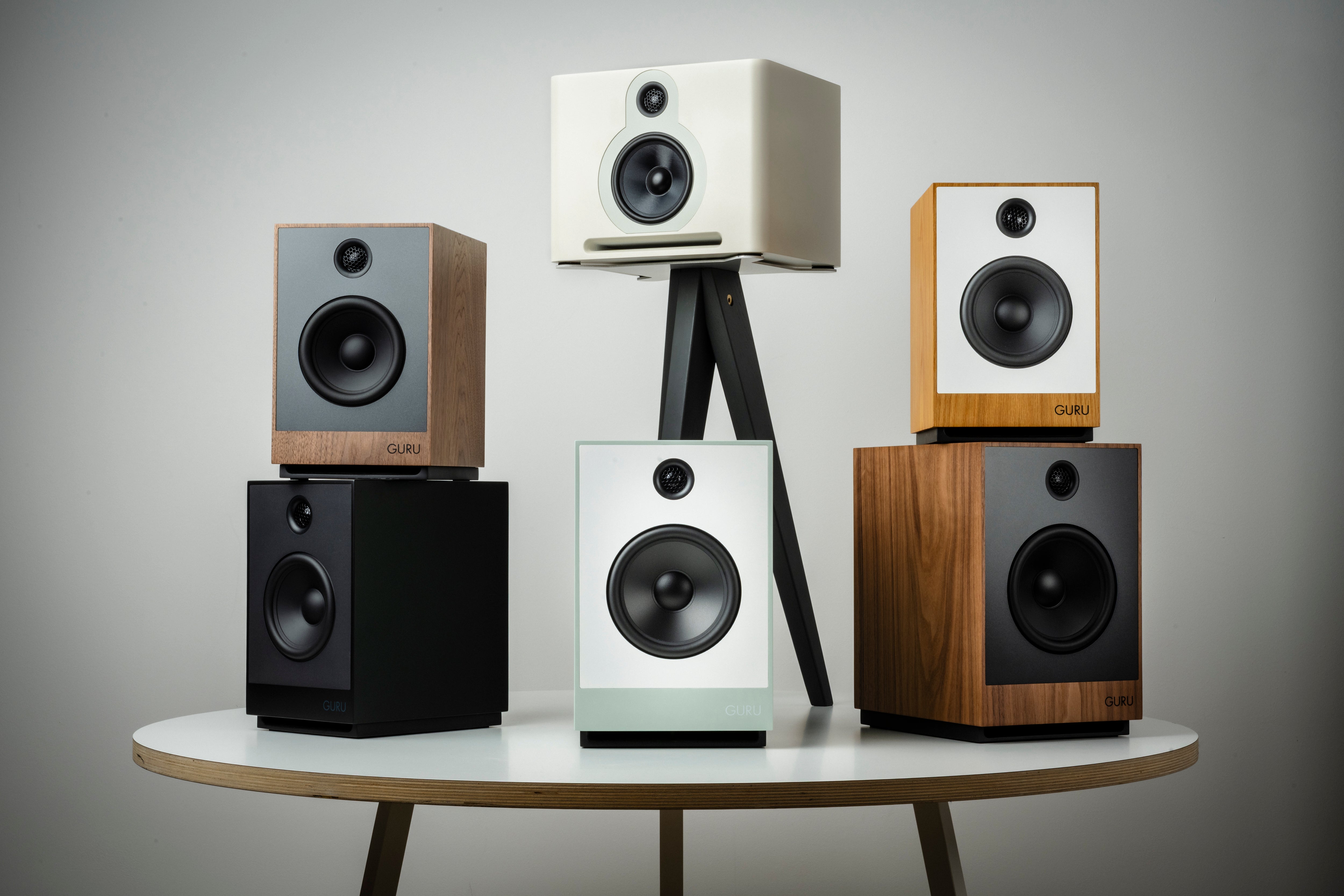
Guru. Everyone else in the standmount business sells you a speaker plus a homework assignment: stands, a foot and a half of breathing room, a dedicated wall, and a partner who has agreed to all of it. Guru committed genuine heresy by designing a small box to be pushed up against the wall, in flagrant violation of every setup commandment in the hobby. The orthodoxy said it couldn't work. Then people heard it. (The engineering behind that heresy is laid out here.) The value case is clever and slightly brutal: most speakers in the world live badly positioned in ordinary rooms, so a design engineered for that reality can embarrass a much pricier speaker set up the way real people set things up, rather than the way reviewers do in a treated basement with no children in it.
Ophidian. The British sub-three-grand standmount bracket is an absolute bloodbath, and most of the field is buying the same Scandinavian drivers, venting them out the back, and differentiating on veneer and ad spend. Ophidian engineered its own approach to how air leaves the cabinet so a small box could behave like a bigger one. That's the expensive, unglamorous, deeply nerdy path — real R&D instead of real marketing — and it shows up as a speaker punching a weight class or two above its sticker. The trade-off is brand recognition, since you've bought something your dealer's other customers have never heard of. The upside is that the man who designed it answers his own email.
Unitra. Retro is a costume now; half the industry is cosplaying 1974 with laser-etched fake patina. Unitra's version is inherited rather than rented — a Polish name with genuine archival weight (the short history is here), dug up and put back to work, making things that look like they come from "somewhere" instead of from a mood board. European manufacturing at prices that suggest somebody in accounting forgot to add the heritage surcharge. It won't be for everyone. I don't much care: it has an accent, and an accent is worth more than another anodized slab.
What I Actually Want
Attainable money. And I mean attainable in the plain sense of the word — not "entry level," not "budget," not the polite little shelf at the front of the shop where we park the things we expect you to outgrow. I mean gear a person with a job and a mortgage and a couple of kids can decide to buy on a Saturday without staging an intervention with their own bank account. Something you save three or four months for, not three or four years. That's the middle. That's the ground I stood in Vienna looking for and mostly couldn't find, and it's the ground where nearly every person I know who loves this stuff got started — one properly good thing, bought at some strain but not at ruin, that made them want the next one.
Design you'd willingly live with, because a stereo is a piece of furniture whether or not the engineer wants to hear that. And the nerve to build something nobody asked for, rather than standing patiently in line waiting for the market to explain what it wants — which the market, historically, has never once known in advance.
None of this is a scandal. It's an ecosystem doing what ecosystems do, everybody behaving rationally, all of it adding up to a slow drift toward heavier, blacker, dearer, duller.
One last thing, and then I'll get out of your way.
I'm closer to the end of this career than the beginning. That does something useful to a person. It means I'm not auditioning for anybody, I'm not worried about which factory stops returning my calls, and I no longer feel the obligation to land every piece on something upbeat and diplomatic — the way you're supposed to, the way nearly every audio "review" does. Because that's the word, isn't it. Reviews. Not critiques. The distinction matters more than anyone admits. A review is a description of a product, written by someone hoping to see the next one. A critique is an argument about whether the thing should exist in the form it does, and it doesn't especially care who's reading.
This is the second kind. It's a critique, offered without a tidy bow on top, by someone who has been in enough rooms to notice a pattern and has run out of reasons to be coy about it.
Music was the point. It was always the point. Somewhere along the way we started collecting the plumbing and forgetting about the water.
Follow the series: every instalment is collected under Listening Room Confidential, and the rest of the Notebook lives here.
Next in the series: Elbows Up, Ears Open — Canada's counter-tariffs skipped hi-fi entirely, and why European and Japanese gear just got the advantage anyway.
FAQ in brief
Is expensive hi-fi actually better?
Up to a point, and the point arrives earlier than the industry likes to admit. Below roughly five thousand, every additional dollar buys audible improvement. Between five and fifteen you're still climbing but paying more per rung. Above fifteen you're largely buying the last three percent — veneer, machining, badge and story.
What happened to mid-priced hi-fi?
It's been squeezed from both ends. Manufacturers chasing shrinking margins have moved upmarket toward buyers with paid-off mortgages, while the budget end has been ceded to lifestyle streaming products. The ground in between, where most enthusiasts historically started, has thinned dramatically.
Why does so much hi-fi equipment look the same?
Because the safest thing to build is the thing already selling in your price bracket. Similar looks cluster at similar prices — you can often guess a product's cost from across a show floor, which suggests very few companies are willing to design against the grain.
What are some good affordable hi-fi brands?
Ruark Audio for design-led systems that sound genuinely good with almost no compromise for most listeners. Guru Loudspeakers for speakers engineered to sit against a wall in a real room. Ophidian Speakers for in-house engineering that punches above its price. Unitra Audio for European manufacturing with actual design heritage.
Is Ruark Audio good quality?
Yes — and the surprise people express says more about the industry than about Ruark. It's design that plays music properly, without demanding a second box, a third cable or a wall you weren't using.
About the author
I've been in and around the audio business for more than forty years. My business card says Founder, which is what you call the person who was in the room before anyone thought to give out titles — hell, before anyone else was in the room at all. Music plays all day, every day, and four decades in, the job is still sitting down and listening to records, or streaming if I don't want to get up. Tell me, what's better than that?
Jeff, Audionation
Founder

Elbows Up, Ears Open