
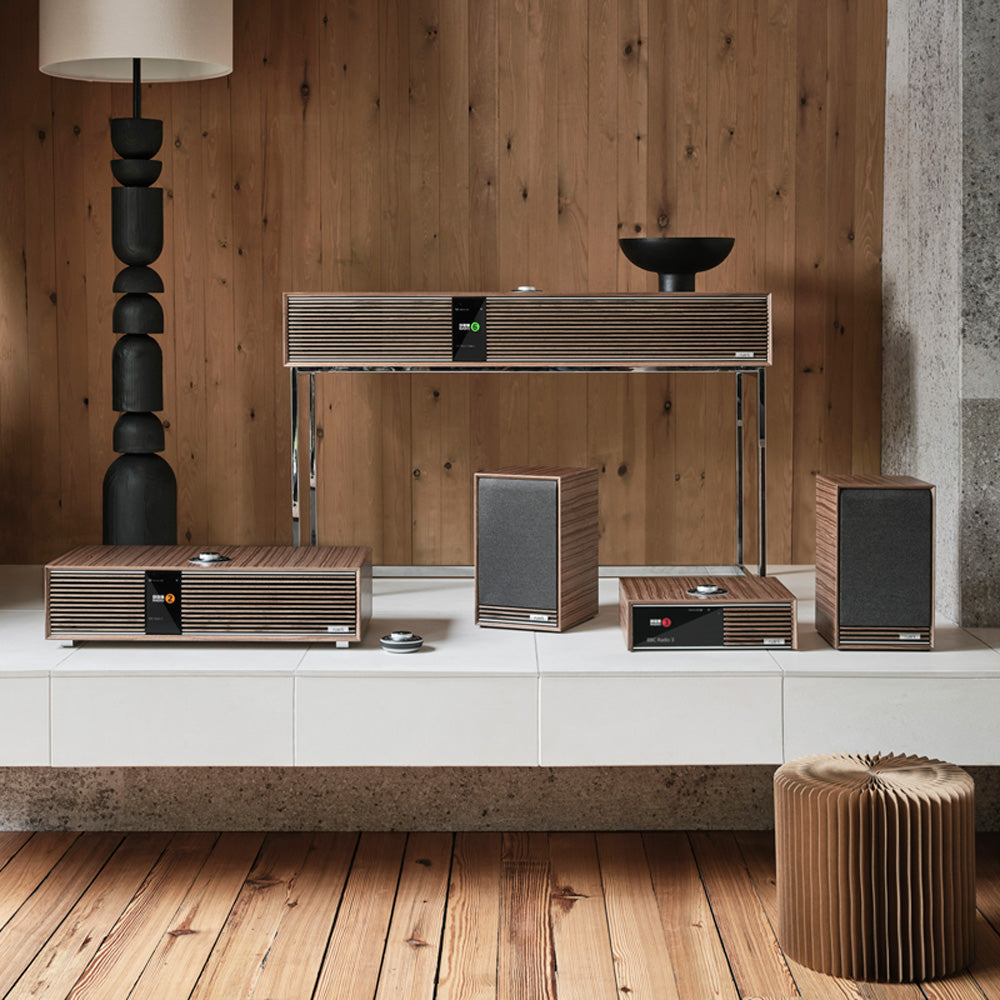

In May 2026, thousands of perfectly good speakers got quieter — not because the hardware failed, but because the servers behind them switched off. Bose ended support for its SoundTouch cloud service on May 6, 2026, closing the book on a smart audio platform it launched back in 2013. If you own a SoundTouch system, or you're deciding what to buy next, this moment says a lot about how modern audio is built — and why we design Ruark systems the way we do.
What happened to the Bose SoundTouch cloud service?
Bose announced that the cloud infrastructure powering SoundTouch would be retired. The company didn't kill the platform entirely: the SoundTouch app was updated so that features which can run locally — Spotify Connect, speaker grouping, and basic playback control — keep working over your home network. But anything that depended on Bose's servers disappeared, including Alexa integration, in-app music service browsing, and presets.
The frustrating part for owners isn't the hardware. A thirteen-year-old SoundTouch 30 can still sound excellent. What aged out was the software ecosystem wrapped around it — and when a product's core features live in someone else's data centre, the product's lifespan is decided in a boardroom, not in your living room.
Why cloud-dependent audio systems fail before the hardware does
Cloud platforms made smart speakers genuinely convenient: streaming service integration, app control from anywhere, voice assistants, multi-room sync. But every one of those conveniences carries a hidden dependency. Servers, security patches, streaming partnerships, and app maintenance all cost money indefinitely, and no manufacturer commits to paying those costs forever.
The pattern is now familiar across the industry, and Bose won't be the last name on the list. The lesson is simple: a speaker's useful life should be determined by its hardware, not by a service agreement. The features that survived the SoundTouch shutdown were precisely the ones that run locally — a strong hint about what to look for in your next system.

How Ruark approaches smart audio differently
Ruark has been building audio equipment in Britain since 1985, starting with the original Sabre loudspeaker. We're a family-owned company with roots in traditional cabinet making, and that heritage shapes a philosophy that happens to be the antidote to the cloud problem: build the intelligence around open standards and put the essentials in the hardware itself.
Every Ruark system is designed so its core functions work without any proprietary cloud service:
- Physical control first. Our signature RotoDial controller means you can wake the system, tune a station, and adjust volume without ever opening an app.
- Radio that can't be switched off remotely. DAB/DAB+ and FM tuners are broadcast technologies — no account, no server, no subscription required, for as long as the hardware lives.
- Open streaming protocols. Streaming on Ruark systems runs over widely adopted standards such as Spotify Connect, Apple AirPlay 2, Google Chromecast and Bluetooth, rather than a single manufacturer-controlled ecosystem. If any one service changes, the others remain.
- Real physical inputs. Line-level and digital inputs mean a turntable, TV, or CD source connects with a cable — a connection no software update can revoke.
- Built to be kept. Hand-finished real wood cabinets, a two-year guarantee (with a free third year when you register), and spare parts available directly from us. We expect these systems to be part of your home for decades, and we support them accordingly.
Ruark vs Bose: feature-by-feature comparison
Bose makes capable products, and its current smart speakers remain convenient while the supporting services run. The comparison below focuses on what matters after the SoundTouch experience: how much of each system's value survives independently of the manufacturer's servers.
| Feature | Bose (SoundTouch era & app-centric models) | Ruark advantage |
|---|---|---|
| Core playback without vendor cloud | Partial — local features survived the shutdown; presets, Alexa and in-app browsing did not | Full — radio, physical inputs and open-protocol streaming all run locally by design |
| Control | Primarily app-driven; hardware presets depended on cloud setup | RotoDial physical controller and remote work with no app or account at all |
| Streaming | Services integrated through Bose's own platform | Open standards — Spotify Connect, AirPlay 2, Chromecast, Bluetooth — maintained by the world's largest tech ecosystems, not one brand |
| Broadcast radio | Internet radio via the platform; no DAB/FM tuner on SoundTouch Wi-Fi speakers | DAB/DAB+ and FM built in — permanently service-independent listening |
| Physical sources | Limited analogue/digital inputs on most lifestyle models | Line and digital inputs across the range; flagship systems welcome turntables and CD |
| Multi-room | SoundTouch grouping originally tied to the Bose ecosystem | Multi-room through AirPlay 2 and Chromecast — mix rooms and even brands freely |
| Build & materials | Quality mass-produced plastics and metals | Hand-crafted cabinets with real wood veneers, designed as furniture that lasts |
| Long-term support | Platform lifecycle decided centrally; SoundTouch retired after ~13 years | Family-owned company selling spares and servicing its own products; guarantee extendable to three years |
Which Ruark system fits your home?

Ruark R410 — the all-in-one music system
The heart of the 100 Series: a complete streaming music system with modern services, generous connectivity, and Ruark's largest drivers in a beautifully finished cabinet. One box, everything you need. Explore the R410.
Ruark R610 — the music console
A step up in flexibility for listeners building a system around multiple sources, designed to anchor a serious yet elegant hi-fi setup. Explore the R610.
Ruark R810 — the flagship radiogram
Our statement piece: a high-fidelity radiogram that revives a golden-age format with thoroughly modern performance — furniture-grade craftsmanship housing a complete music system. Explore the R810.
Frequently asked questions
Does my Bose SoundTouch speaker still work after the shutdown?
Yes, partially. Bose updated the SoundTouch app so local features — Spotify Connect, speaker grouping, and basic playback — continue over your home network. Cloud-dependent features such as presets, Alexa integration and in-app music browsing are gone.
Will Ruark systems stop working if a streaming service changes?
No single service is a point of failure. Ruark systems combine several independent open protocols (Spotify Connect, AirPlay 2, Chromecast, Bluetooth) with DAB/FM radio and physical inputs, so core listening never depends on one company's servers — including ours.
Is Ruark a good alternative to Bose?
If your priorities are longevity, craftsmanship, and features that work without a proprietary cloud, yes. Bose remains a strong choice for app-centric convenience while its services run; Ruark is built for listeners who want a system they'll still be enjoying — fully — for years.
Can I use Ruark systems for multi-room audio?
Yes. Multi-room on Ruark runs over AirPlay 2 and Chromecast, so you can group Ruark systems together or alongside other compatible speakers, without a brand-specific platform.
The bottom line
The SoundTouch shutdown isn't a reason to distrust smart audio — it's a reason to choose smart audio that's built to survive. When the intelligence lives in open standards and the quality lives in the hardware, there's no server switch-off that can take your music away. That's the principle every Ruark system is built on, and it's why the system you buy from us today is one we expect your family to still be using long after this news cycle is forgotten.

Guru Speakers and the Science of Wall Placement | Audionation