

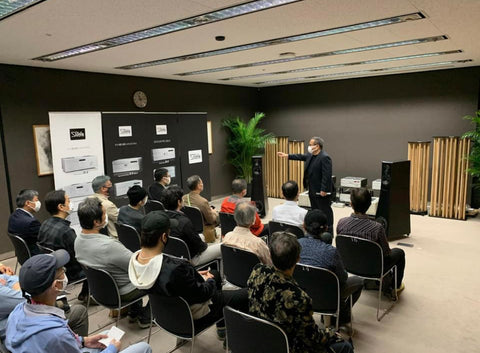
Why does Soulnote build amplifiers without negative feedback, offer a non-oversampling mode on its DACs, and leave its top covers deliberately unfixed? The answers come from one design philosophy, set out by Soulnote's chief designer in a twelve-part series. This is the complete series in one place, translated from the Japanese and lightly edited.
The philosophy in brief
- Specs measure sound with time removed. Catalogue figures come from steady sine waves, but music is amplitude and time.
- Chasing specs can make sound worse. Negative feedback and steep digital filters improve the numbers but can blur timing, which our hearing is most sensitive to.
- The chassis is part of the sound. Damping and resonance both colour music, so Soulnote uses loose, unfixed construction instead of heavy damping.
- Design by ear, measure later. Measurements are for catching production faults, not for deciding what sounds right.
Audionation is the exclusive Canadian distributor for Soulnote.
About Soulnote and its chief designer
Soulnote is a premium audio brand of CSR Corporation in Kanagawa Prefecture, Japan, founded in 2004 by Norinaga Nakazawa, a former director of Marantz Japan. The company has a team of around 50 people.
Chief designer Kato completed postgraduate studies at Tottori University and joined NEC's audio engineering department in 1989. When NEC left the audio business he moved to Nippon Marantz, developing non-feedback power amplifiers for professional use and the Philips LHH series. In 2005 he joined Nakazawa at CSR to design Soulnote products, and in 2016 he became Soulnote's chief engineer, responsible for everything from product planning and electrical and structural design to sound quality. Nakazawa's brief was simple: "Make SOULNOTE the world's premier audio brand."
In 2021 the S-3R, X-3 and Z-3 were chosen as the reference system for the listening room of StereoSound, a leading Japanese audio magazine, and in 2022 Soulnote entered the North American and European markets, beginning at the Munich High End show.
Models developed under Kato as chief engineer:
- 2016: A-1, C-1, E-1, A-0
- 2017: D-1, A-2, E-2
- 2018: D-2, D-1N
- 2019: S-3
- 2020: S-3 ver.2, P-3
- 2021: ZEUS (D-3, Z-3, X-3, RCC-1), S-3 Reference
- 2023: ZEUS A-3 (updated)
1. The gap between specs and sound
Catalogue specifications, or "static specs", are figures such as distortion, frequency response and signal-to-noise ratio. They are measured mostly with sine waves and are easy to quantify. Yet audio enthusiasts know that sound quality cannot be judged by these figures alone, and that cables and racks can change the sound even when the measurements show no difference.
The industry still leans on the assumption that better specs mean more accurate sound. If a circuit change improves the specs and changes the sound, most engineers instinctively call the better-measuring version the better sound. A new product with wonderful sound but weaker specs than its predecessor might never be approved for release.
Kato describes building amplifiers as a student, judging them only by how much he enjoyed the music. When he finally bought measuring equipment, the results were disappointing, so he modified the design until the numbers improved. The result measured better but sounded dull and lifeless. That puzzle occupied him for four decades and led to a conclusion: specifications are not the definitive yardstick of sound quality, and improving them can sometimes make the sound worse.
2. Not everything valuable can be measured
Two dishes made from identically weighed ingredients taste different in the hands of a great chef and an amateur, because cooking depends on skill that no scale can capture. Two cars with the same power and weight can post different lap times, because chassis rigidity and suspension tuning decide how they corner, and no catalogue lists cornering ability. Even in Formula 1, final tuning still needs a driver.
Audio is different in one important way: sound quality doesn't just resist measurement by specs. Sometimes better specs actually degrade it.
3. Fourier's curse: sound without time
Sound has two dimensions, amplitude and time. Every recording, analogue or digital, records amplitude over time. There is no such thing as a "still sound" in the way there is a still image.
Catalogue specs are usually measured with continuous sine waves, which have no dynamic variation, so the time element is largely absent from the results. FFT analysers, the standard tool for sound analysis, convert time into frequency for convenience, and in doing so set the time dimension aside. Kato calls this habit of privileging frequency over time "Fourier's curse".
He divides performance into two kinds:
- Static performance: what can be catalogued, such as distortion, frequency response and noise.
- Dynamic performance: behaviour in time, which resists measurement. Like a chef's skill or a car's cornering, it can only really be judged by experiencing it: tasting, driving, listening.
Beyond a certain point, the two trade off against each other. A drag car built for 400 metres in a straight line may beat a Formula 1 car on a straight, but it can't turn, so it is useless on a circuit. Listening to music is like driving a winding circuit. Equipment over-optimised for static performance loses the ability to reproduce music faithfully.
4. Hearing beyond the "frequency brain"
We usually think about sound in terms of bass, midrange and treble, a habit Kato calls the "frequency brain". It is commonly said that humans can't hear above 20 kHz. That is true for sine waves, but if the content above 20 kHz is cut away, listeners can still sense the difference in how a musical waveform rises.
The sushi analogy makes the point: blend a master's sushi and an amateur's sushi made with the same ingredients, analyse the mixture, and you'd conclude they taste the same. Eat them unblended and they are completely different. Measurement focused on static performance is the blended analysis; it misses the experience.
Stereo imaging is further evidence. Good equipment can create a convincing three-dimensional image from two speakers, and the timing differences involved correspond to frequencies far above 20 kHz.
5. Why our ears favour timing
Kato argues that our sensitivity to dynamic sound is inherited from our survival instincts. Just as a hawk spots moving prey more easily than still objects, and a waving hand stands out in a crowd, our hearing is tuned to sudden, changing sounds: the snap of a branch at night, the footsteps and direction of a threat. Constant sounds posed little danger, so we pay them less attention.
Cutting away content above 20 kHz because sine waves up there are inaudible improves static performance but harms dynamic performance, and the result sounds less real. Steep low-pass filters, oversampling digital filters and digital phase-locked loops are not inherently wrong, but they can obscure the essence of the sound when designers ignore how human hearing works.
6. Why Soulnote uses no negative feedback
Negative feedback (NFB) is used in almost every amplifier because it lowers measured distortion. In Soulnote's experience it can also make music sound lifeless. That is why Soulnote amplifiers, DACs and phono stages are designed with no global negative feedback, in favour of a more vivid, immediate sound. Kato describes Soulnote itself as a real-world test of the idea that too much focus on static performance diminishes dynamic performance.
Where you'll hear it: every Soulnote amplifier, from the A-0 ver.2 and A-1 ver.2 to the A-2 ver.2 and flagship A3.
7. NOS mode: worse measurements, better sound
One of Soulnote's best-known features is its non-oversampling (NOS) mode. In conventional FIR (oversampling filter) mode, a sine wave looks pristine, but an impulse shows artificial pre- and post-echoes created by the digital filter. In NOS mode, the sine wave looks rough, yet the impulse is much cleaner. NOS measures worse and has been widely praised for how it sounds.
NOS exists because Kato listened before measuring. During a DAC experiment, an accidental setting produced a far better sound. Only afterwards did the waveform reveal its stair-stepped shape, the result of oversampling having been switched off by mistake. Had he looked at the waveform first, he would have "fixed" it, and NOS would never have existed. Soulnote DACs let you switch between NOS and FIR so you can hear the difference for yourself.
Where you'll hear it: the D-2 ver.2 reference DAC.

8. The chassis is part of the sound
Many high-end products are heavy and rigid. Soulnote products have unfixed panels and light construction. Why?
In Kato's experience the enclosure affects sound more than many electrical components. A prototype that sounds open with its top panel off can sound noticeably more confined once the panel is screwed down. Vibration is the cause, but the usual cures, rubber isolation and added weight, often make things worse, because every damping material has its own frequency character that colours the sound. Letting vibration stay light and free is often better.
Damping smears time
Physical damping also delays energy and overlaps it with the original signal, blurring the waveform in time. Even air can act as a damper: trapped inside a sealed case it becomes viscous, like rubber. That is why Soulnote's top covers are designed not to trap air and rest on spikes rather than being bolted down, and why open audio racks suit Soulnote equipment better than enclosed cabinets. The same thinking produced Soulnote's RSC speaker cables, which are thin, light and work best suspended in the air.
Resonance colours frequency
Every object rings at its own frequency when struck. If that resonance is sharp and strong (high Q), it adds a persistent ring that makes music sound repetitive and flat. Tapping a component often predicts its sound: a film capacitor that gives a sharp ring when tapped tends to sound shrill.
The usual fix, damping with rubber, suppresses resonance but also deadens the sound. Soulnote instead loosens the structure, like a guitar with slack strings, which lowers resonance and stops it travelling from one part to another. A bolted-down top cover creates a stiff monocoque that strengthens resonance across the whole chassis, so Soulnote leaves it unfixed. The chassis combines aluminium and steel, since all-aluminium cases are highly resonant, and the joints are kept deliberately loose.
The circuit board rests on three pillars without being fixed, so chassis vibration from sound pressure and the power transformer doesn't reach the components, and the board avoids resonances of its own. The terminals are unfixed too, so cable weight and vibration don't damp the chassis.
In short: resonance mainly disturbs frequency; damping mainly disturbs timing. The audio industry has spent decades fighting resonance. Kato believes damping is at least as harmful, because human hearing is so attuned to timing.

9. Design by ear, measure later
Kato always designs with music playing. How far should static performance be optimised? His answer: until there are no problems when listening to music. If a phono stage's residual noise is quieter than the sound of a stylus tracing the groove, it is acceptable, and the goal becomes maximising dynamic performance.
Measurement comes later, to catch faults in mass production. During design he deliberately avoids it, so catalogue numbers can't bias his judgement.
People often ask how Soulnote "creates" its sound. The answer is that it doesn't. Audio equipment shouldn't create sound; it should extract everything that is already in the recording, whether vinyl, CD or file. Designs that prioritise static performance produce stale sound, which is then "improved" with component tweaks. When dynamic performance comes first, those tweaks become unnecessary; the job is simply to remove the bottlenecks. As Kato puts it, stale sushi can't be made fresh again with seasoning. If the recording is the meal, audio equipment should be the cutlery: neither flawed nor artificially sweetened.
Sound quality isn't only for experts. When equipment is faithful to timing, most people can hear the difference. Every recording preserves the soul of the musicians who made it, and Soulnote's mission is to bring that soul back to life.
Frequently asked questions
What does non-NFB mean?
NFB stands for negative feedback, a circuit technique used in most amplifiers to lower measured distortion. Soulnote designs without global negative feedback because, in its experience, feedback improves the numbers at the cost of timing and life in the music.
What is NOS mode on a Soulnote DAC?
NOS (non-oversampling) mode turns off the oversampling digital filter. It measures worse with sine waves but avoids the pre- and post-echoes that digital filters add to transients. Soulnote DACs let you switch between NOS and conventional FIR filtering.
Why are Soulnote top covers loose?
An unfixed cover avoids trapping air (which acts as a damper), prevents the chassis becoming a stiff, resonant monocoque, and stops the cover's own resonance passing into the main chassis.
Who designs Soulnote products?
Soulnote was founded in 2004 by former Marantz Japan director Norinaga Nakazawa. Its chief designer, Kato, previously developed non-feedback power amplifiers at Nippon Marantz and has led Soulnote's design since 2016.
Where can I buy Soulnote in Canada?
From Audionation, Soulnote's exclusive Canadian distributor, with shipping across Canada, or from an authorized Audionation dealer. See the full Soulnote range, and read about Soulnote's home in Japan.