
Listening Room Confidential, No. 5 — an occasional series.
Last month I wrote a column telling several thousand strangers how to behave at a hi-fi show. Sit down. Ask for the volume to come down. Don't be the person reading the binding posts. It's a bold thing to do when you're also the person standing in a room for three days with a name badge and a jar of mints.
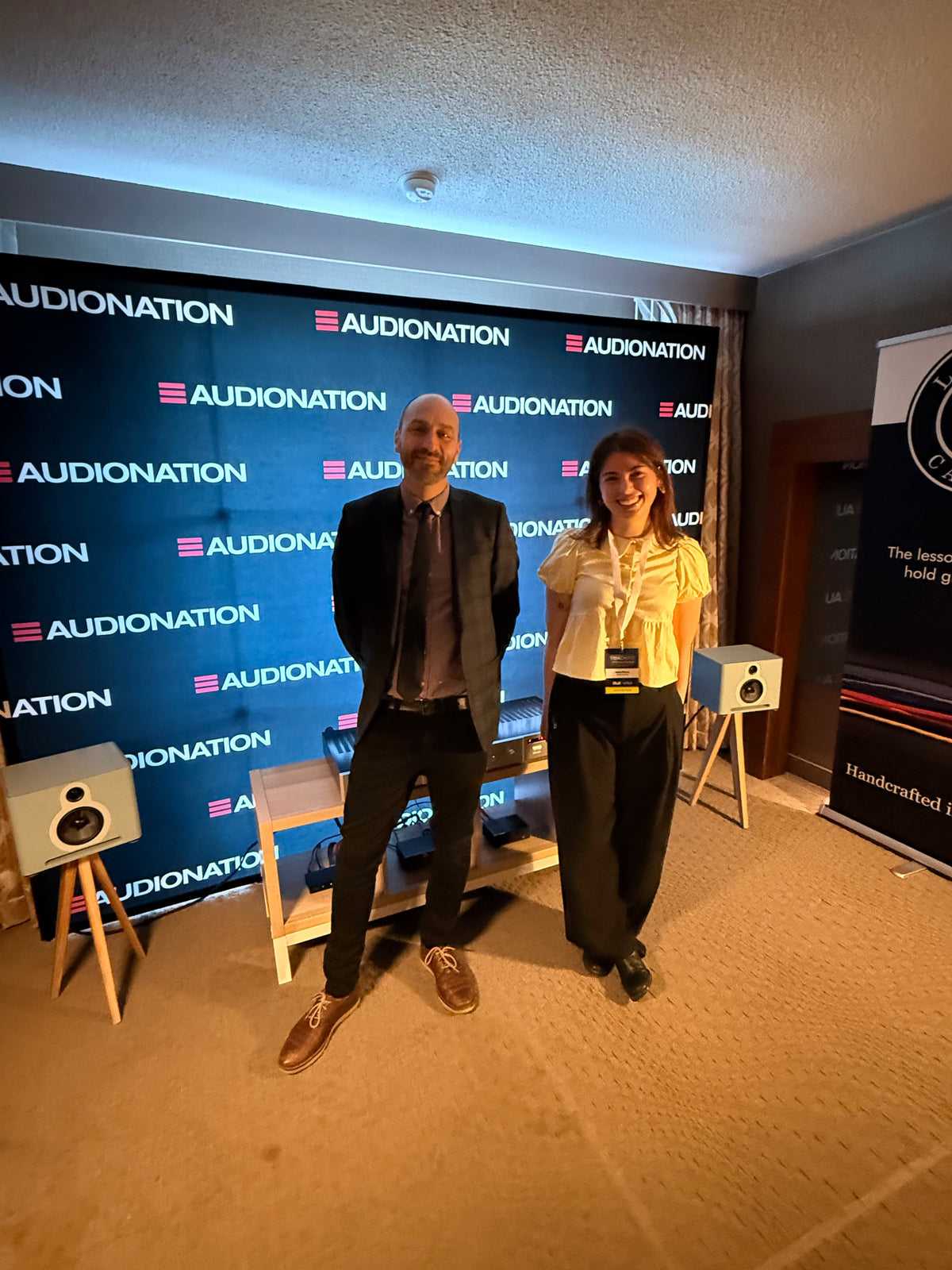
Make that two rooms. We had two this year: one for Ruark, and one for Soulnote, Guru and Luna cables. I walked between them so often that the hotel carpet and I are now on a first-name basis.
So, as promised: a report on whether the rules survived the Toronto Audiofest. Short version: most of them did. I broke two myself. I won't say which. A person who writes the rules is entitled to a little discretion, and the only witness was a Do Not Disturb sign, which is professionally committed to not getting involved.
Two rooms, two jobs
The Ruark room was the living room: furniture that plays music, the kind of system a person can picture on their own sideboard. The other room was the listening room: Soulnote electronics from Japan driving small Guru Q10 speakers, with Luna cables handmade in Montreal tying it all together. Between them we covered most of what a household needs, which is somewhere to relax and somewhere to be politely astonished. Both rooms had a chair, a playlist, and somebody willing to stop talking.
Rule one: Sit down
This one works, and the proof walked in from Montreal. Several customers came back more than once to both rooms to sit with the systems, which is the highest compliment a show room can get. Nobody comes back to a room they were merely polite about. A standing person is a leaving person; a returning person has already taken their coat off. By Saturday afternoon I was a strong supporter of sitting down myself. For once the hobby and my feet were in complete agreement.
Rule two: Ask for the volume to come down
I asked, in both rooms. Everyone said the volume was fine. Nobody asked for it to be quieter, and several asked for bass demos or a different song, which is the healthiest kind of request a room can get. A show room where everybody is happy with the volume is like a baby who's quiet at a wedding: you check twice to make sure nothing is wrong. Nothing was wrong. I'll take “fine” as a pass.
The Diana Krall experiment
You'll remember the confession: for years we kept her off our playlist because her recordings are too well made. This year she was back in the pile, and she got played, and it was great. She was even requested a few times. A Canadian from Nanaimo got requested in Canada. The system has since recovered.
Who actually ran the room
I didn't choose the music in the Soulnote and Guru room. Ruby Nikols did. Ruby is a recording engineer, and she picked the songs and ran that room for the entire show, which spared everyone the usual exhibitor habit of playing the track they've played four hundred times because it flatters their gear. Ruby chose music the way someone who's spent her young life on the other side of the glass chooses it: for what's on the tape.
She also snuck in Taylor Swift's “Fortnight,” and the production surprised everyone. It put the “just play regular music” crowd completely at ease, and it sounded great. Which brings me to the Diana Krall connection, such as it is: talent doesn't need a loud introduction, whether it's at the piano or at the faders. Both of them kept the room sounding good. Thank you, Ruby. You made me look like I'd planned it.
A new rule, courtesy of the weekend
Here's one I didn't write down before the show. When you walk into a room, the track that's playing may well be somebody else's request, which might not be the best track for that system or that room, but it matters a great deal to the person who asked. So don't judge a system on one track. Sit, listen, or make a request of your own before you take a position. A room is a conversation, not a verdict.
My favourite moment of the weekend was a young girl and her father who walked into one of our rooms together. She was plainly running the show: she picked the songs, she knew what she liked, and she was a total pro. Her father mostly nodded and followed. I look forward to the day she joins the industry. I hope I'm still around to hire her.
After the doors close
Every trade has a place where the real information moves. In a restaurant kitchen it's the staff meal before service. In hi-fi it's the hotel bar around eight o'clock on Friday, when the doors close and the name badges start to droop.
Picture it. People have flown in from Europe, the United States and every corner of Canada, which makes it the most international room in Etobicoke that weekend. Nobody in it has sat down in nine hours, so the first round is mostly structural repair. Somebody orders an Irish whiskey (you know who you are), which at that hour is less a drink than a position paper. It settles two arguments and starts four more.
Then come the rumours, which travel faster than freight. Who's moving, who's merging, who has a new distributor and who's pretending not to be talking to one. And then the theories, which are the best part. Everybody at a hi-fi bar has a plan for fixing everything, and almost none of the plans have anything to do with music or with the competition, which was playing a better demo than ours two doors down and which we all adore.
A small sample, composite and anonymous because I'd like to be invited back: that the whole industry would be healthier if shows opened an hour later; that the real threat to hi-fi is airline legroom, since a person who's been folded into a seat for seven hours does not want to sit in a chair and listen; and that the entire economy could be fixed with a better hotel elevator. I have heard worse economic policy on the radio.
None of it will happen. All of it was said with total conviction. That's the staff meal, and I wouldn't miss it. Sleep, in this arrangement, is optional. By Sunday I was running on about as much of it as a person on a long flight, and my feet had filed a formal complaint with management.
Hotel rooms and the good people who make them work
The load-in and load-out were an absolute breeze for both rooms, and that speaks to the experience of Sarah, the show organizer, and her team. We joked that if the rooms could be a little longer next year it would help the soundstage. I say that with total affection and a full understanding that a hotel does not take requests for room length, but we had to ask.
Then there's the gear in the second room. Luna cables are handmade with care in Montreal, Canada, which matters to me and to a lot of Canadians these days. Danny and Rowan from Luna were generous with their time and their patience in our Soulnote and Guru room, and the system sounded natural and unforced. The small Guru Q10 speakers surprised a lot of people, and here's the part that deserves more credit: much of that expansive sound came from the synergy with Soulnote. Built in Japan by the original Marantz team, the Soulnote electronics gave the Q10s the control and openness that make a small box sound like a big room. I made the case for that pairing in Hold the Feedback, and the room made it better than I could. The speakers collected the compliments; the amplifier did the heavy lifting. I've been in this business long enough to know which one deserves the thank-you note. Thank you, Danny and Rowan, for the help and for wonderful products.
A special shout out to Rowan and Danny for the coffee and the fine choice of Japanese restaurant, where the sake arrived in cups small enough to make everyone at the table look like a careful person. We're not sharing which restaurant so we can be sure to get in next year, and the team from Soulnote would definitely have approved.
The middle, found
In August I complained about the missing middle. The show ran from $3,000 to $1 million, a spread wide enough that somebody, somewhere, was explaining to a spouse that the speakers cost less than the car. Our two rooms were built on the idea that a person shouldn't need to live at the far end of that range to hear something properly good. Customers came back to both rooms for a second listen, and the Guru Q10s, driven by Soulnote, surprised people with how much sound came out of so small a box. That's the middle, and it's alive.
What I'd tell you now
Rules are easy to write at a desk. They're humbler on Friday afternoon with a line out the door and a pair of sore feet. But here's what I'll stand behind: the best rooms weren't the biggest or the dearest. They were the ones where somebody chose the music with care and somebody else sat down and listened. Thank you to everyone who came by either of our rooms, whether you came from down the road or across the Atlantic, who took the second-best chair, and who never once asked about damping factor.
Music was the point.
Follow the series: every instalment is collected under Listening Room Confidential, and the rest of the Notebook lives here.
Previously: Hold the Feedback, How to Listen, Elbows Up, Ears Open and Has Hi-Fi Lost the Plot?.
FAQ in brief
What's the best way to listen at a hi-fi show?
Sit down, listen to more than one track, and make your own request before judging a system.
Can a small speaker sound big?
Yes, with the right partner. The Guru Q10 surprised a lot of visitors at the show with its expansive sound, thanks in large part to its pairing with Soulnote electronics.
What do industry people talk about at the bar?
Rumours, theories about fixing the economy, and one person's complete plan for hotel elevators. Very little of it concerns music.
Where can I hear the systems?
Soulnote, Guru and Ruark are all available through Audionation dealers. Find a dealer near you.
About the author
I've been in and around the audio business for more than forty years. My business card says Founder, which is what you call the person who was in the room before anyone thought to give out titles — hell, before anyone else was in the room at all. Music plays all day, every day, and four decades in, the job is still sitting down and listening to records, or streaming if I don't want to get up. Tell me, what's better than that?
Jeff, Audionation
Founder

Hold the Feedback