If you have any questions, you are always welcome to contact us. We'll get back to you as soon as possible, within 24 hours on weekdays.
-
Shipping Information
Use this text to answer questions in as much detail as possible for your customers.
-
Customer Support
Use this text to answer questions in as much detail as possible for your customers.
-
FAQ’s
Use this text to answer questions in as much detail as possible for your customers.
-
Contact Us
Use this text to answer questions in as much detail as possible for your customers.
5510 Series
Exposure finally owned up to 120 watts. The lab still found 135.
The flagship integrated. A 120-watt output stage, a line stage measuring under 0.01% distortion, one plug-in bay, and a white OLED display with five brightness settings that will go dark entirely. Black only. Designed and built in Lancing, West Sussex.
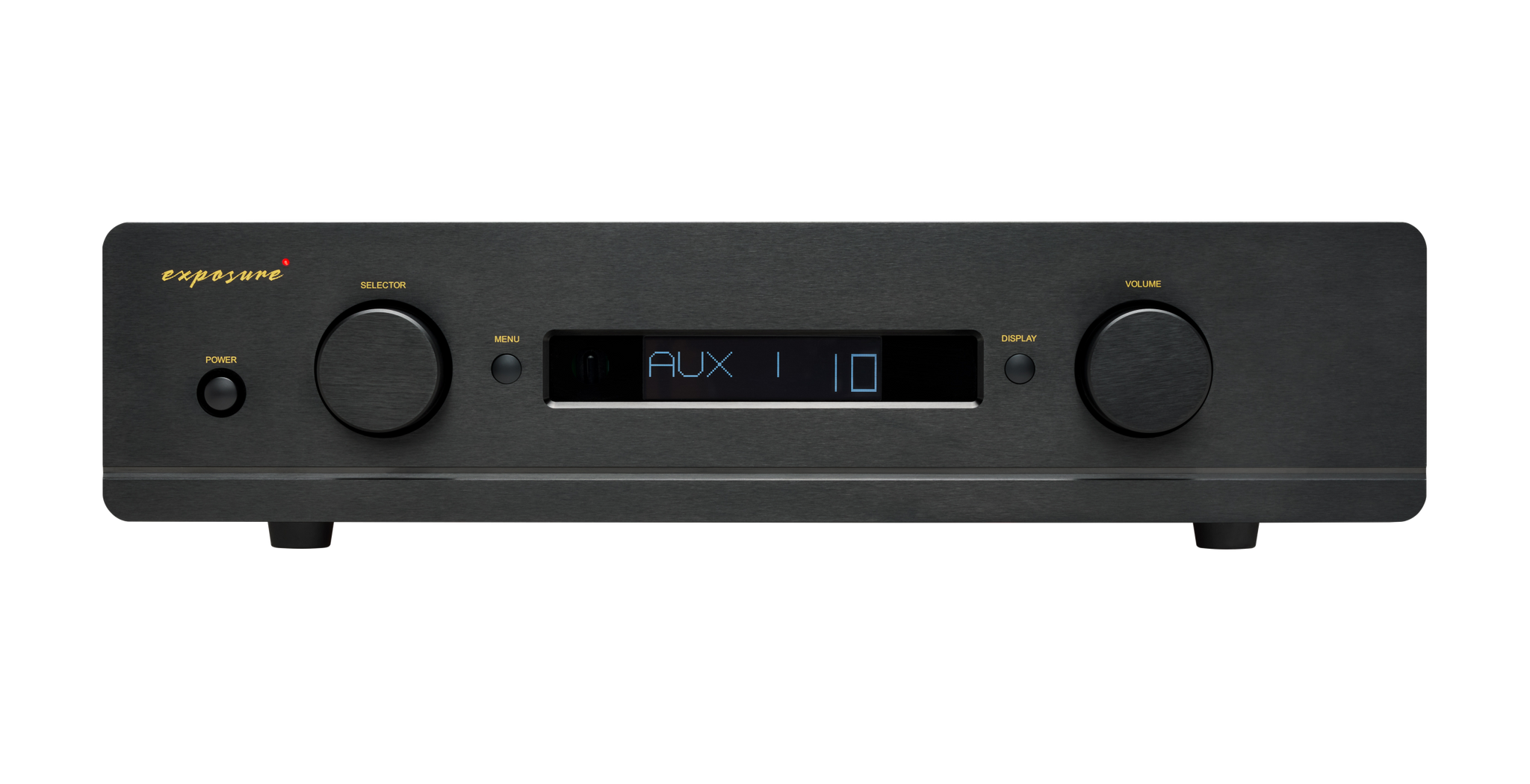
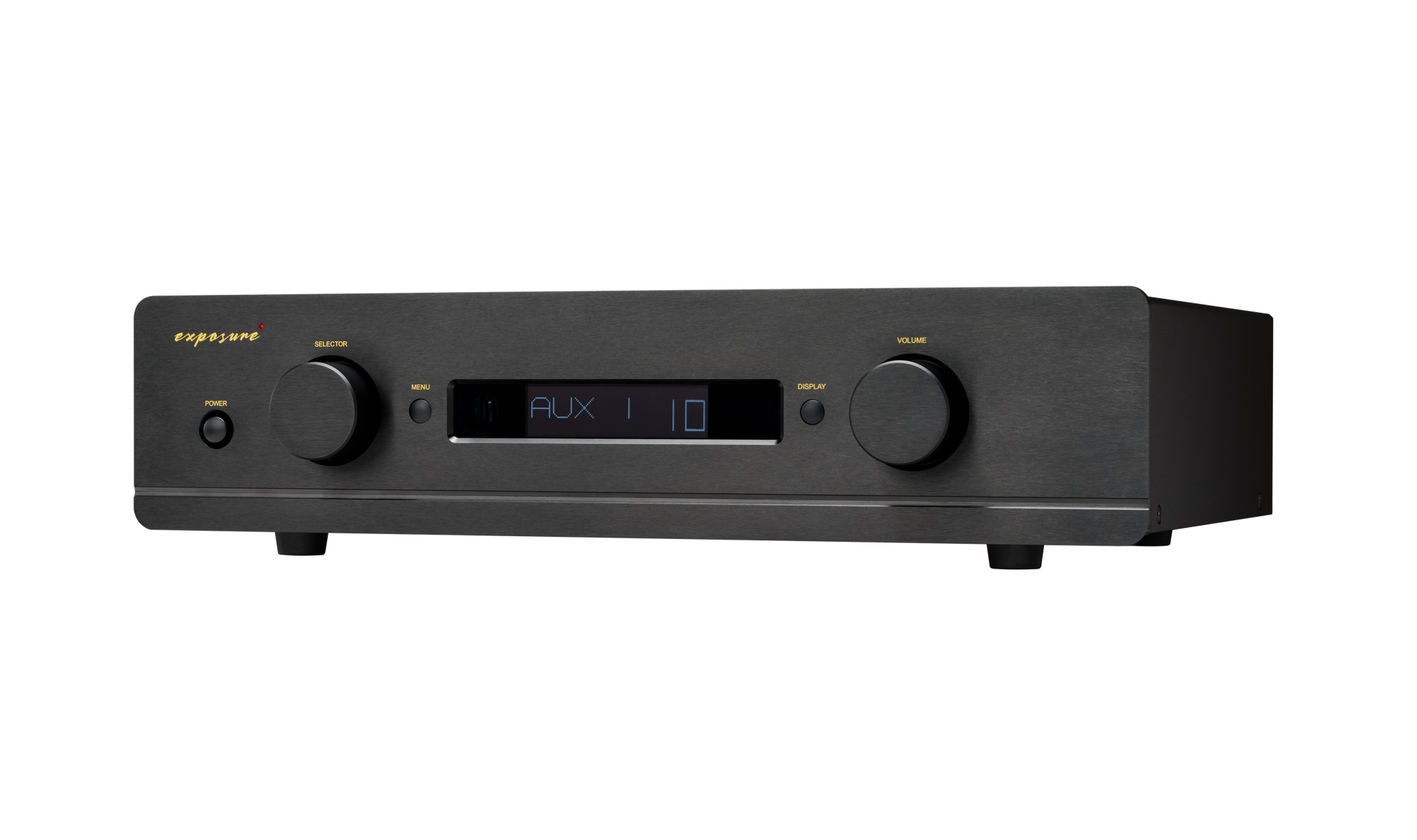
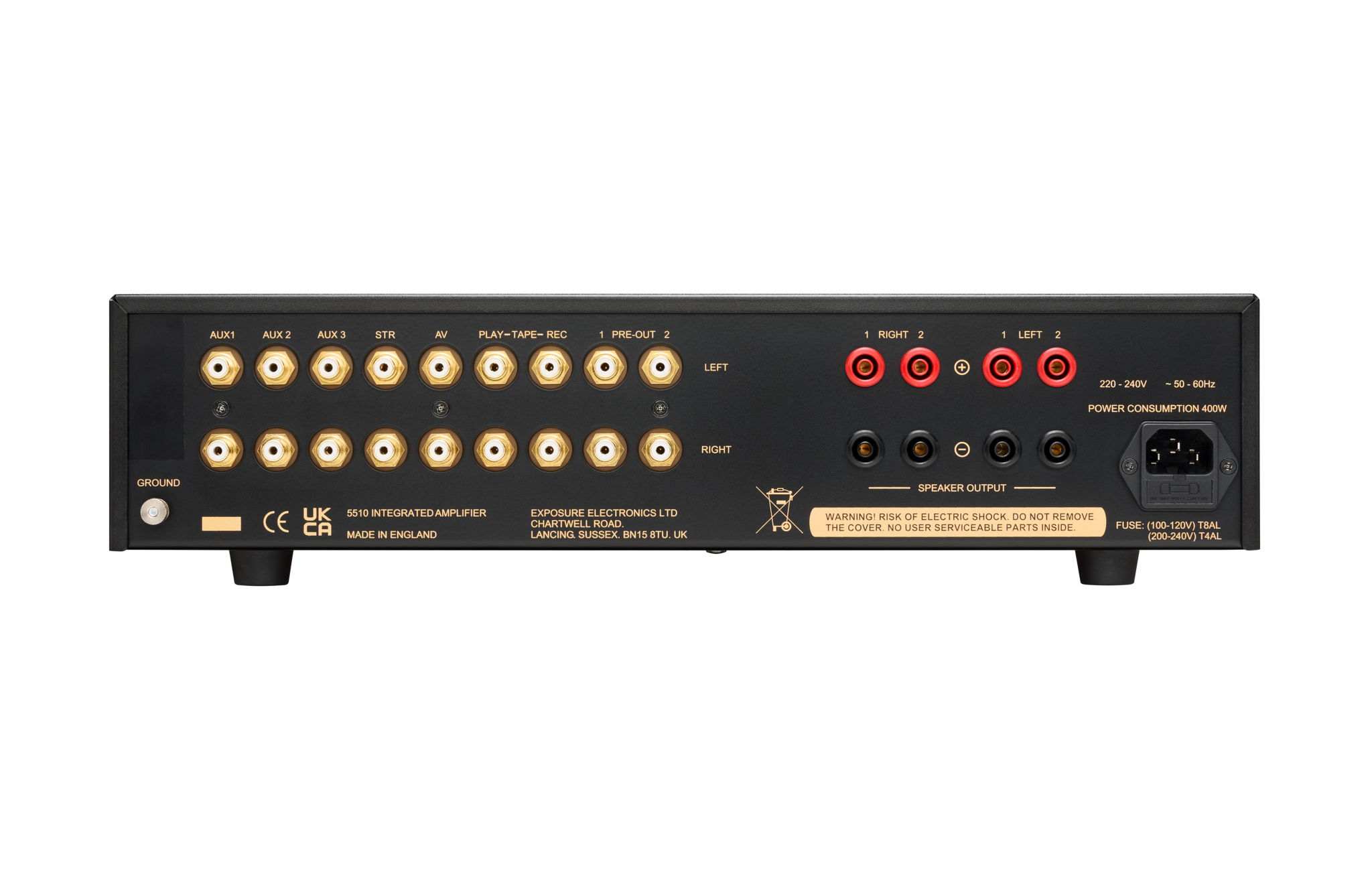
Exposure 5510 Integrated Amplifier
Popular upgrades
Pairs well with
Designed and built in Lancing, West Sussex since 1974. Three-year guarantee.
Exposure 5510 Integrated Amplifier
Top of the range
There is nothing above this one.
Measured Measured 135 W into 8 ohms against a 120 W rating, with 28.5 A maximum current and 820 W dynamic into 1 ohm. Hi-Fi News lab report, Paul Miller, December 2025.
- XMHalf-width separates. Phono, integrated, pre, mono, headphone, CD.
- 2510Full-width. Seventy-five watts, with an MM phono stage as standard.
- 3510The complete tier. Integrated, pre, stereo power, monoblocks and CD.
- 5510The current flagship. One hundred and twenty watts, black only.You are here
Within this tier
- Integrated
- Pre
- Stereo power
- Monoblocks
- CD player
One bay
One slot. Four boards. Choose deliberately.
- MM phonoFor moving magnet cartridges.
- MC phonoFor moving coil cartridges.
- DS AudioFor DS Audio optical cartridges. An unusual factory option at this price.
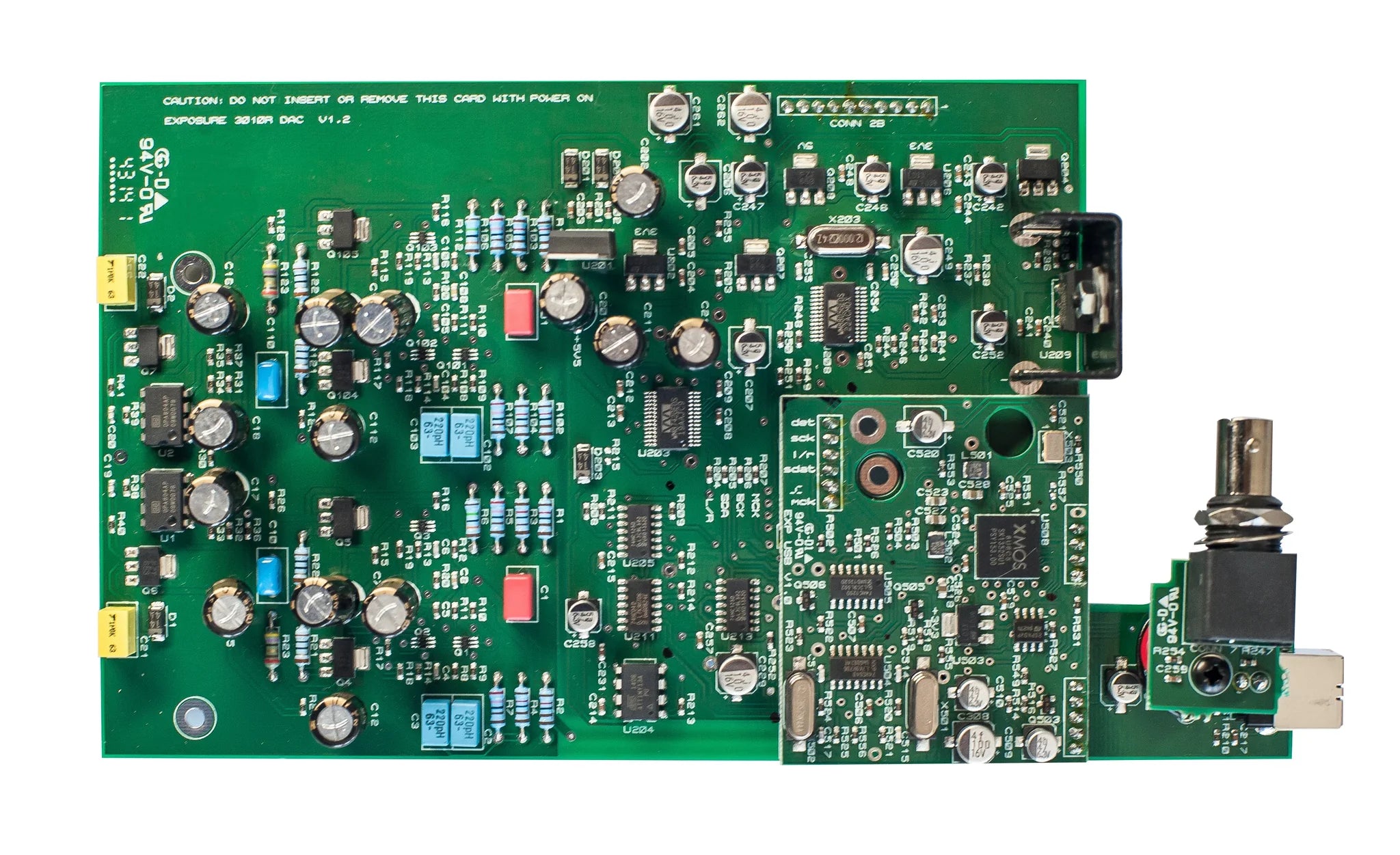
- DAC+BNC or optical in, plus USB to 32-bit/768kHz and DSD. All-discrete output stage, no integrated circuits in the signal path.
The chassis takes one board at a time, and a fitted board uses one of the six line inputs — so it is six line inputs, or five plus a board.
Power, Purity, Restraint
The flagship still knows when to go dark.
The most power in the range, from a custom-wound toroidal transformer with integrated hum shielding.
The line stage measures under a hundredth of a percent at 1 kHz — tighter than the 3510 integrated by a factor of three, in a box that also drives the speakers.
A white OLED display that will go dark entirely. On a brand that leaves most of its boxes without a screen at all, being able to remove the light is the point.
Technical specifications
| Power output | 120 W per channel into 8 Ω @ 1 kHz |
| Distortion, power amplifier | <0.02% at rated power into 8 Ω, ref. 1 kHz |
| Distortion, preamplifier | <0.01% @ 1 kHz, rated power |
| Frequency response | 20 Hz – 20 kHz ±0.5 dB |
| Signal-to-noise ratio | >100 dB (A-weighted), ref. 1 kHz at rated output |
| Channel separation | >60 dB @ 20 kHz |
| Preamplifier gain | ×7.6 (+17 dB) at maximum volume |
| Input impedance | >10 kΩ |
| Output impedance | 50 Ω, ref. 1 kHz |
| Inputs | Six line inputs, or five plus one plug-in board |
| Speaker terminals | Shrouded bi-wire pairs, 4 mm banana plugs only — no bare wire or spade lugs |
| Power consumption | <400 W, 8 Ω load, both channels driven |
| Dimensions and weight | 440 × 115 × 315 mm (W × H × D), 12 kg net / 14 kg gross |
What makes the 5510 the flagship?
Can I fit a phono board and a DAC board?
Can the display be turned off?
About the Exposure 5510 Integrated Amplifier
The Flagship: Fifty Years of British Amplification, Distilled
Since 1974, Exposure has built amplifiers for people who buy hi-fi to hear music, not to admire blinking lights. The Exposure 5510 Integrated Amplifier is the new flagship of that lineage — the first model in the top-of-range 5510 Series, delivering 120 watts per channel of Class AB muscle through the most advanced circuitry the Brighton-based brand has ever put in a single box. Hi-Fi News' verdict on the flagship was simple: "music-making doesn't always sound this effortless." Quiet authority, in other words — the Exposure way.
What Makes It the Flagship
The headline is the volume control. Exposure retired its traditional potentiometer in favour of a stepped resistor-ladder attenuator — the approach found in cost-no-object preamplifiers — giving precise, perfectly channel-matched adjustment across a massive ~95 dB range. It's paired with another Exposure first: a discreet OLED display showing input and volume, readable across the room, with five brightness levels and an auto-off mode for lights-out listening.
Under the lid, the output stage borrows its DC-coupled topology, complete with DC servo, from Exposure's 3510 monoblock power amplifiers — eliminating a large capacitor from the signal path, to the direct benefit of transparency. Four Toshiba output transistors per channel deliver the rated 120 W into 8 ohms with genuine reserves for low-impedance loads, fed by a custom toroidal transformer with hum shielding inside a resonance-controlling aluminium chassis. Hi-Fi News' lab and listening tests found a true all-rounder: unfatiguing midband warmth, deep and agile bass, and real speaker-driving grip, refined enough for solo violin and muscular enough for an orchestral crescendo. And in classic purist fashion, there's no headphone amp, no streaming module, no gimmicks — every pound of the budget went into the amplification.
Modular by Design: Grows With Your System
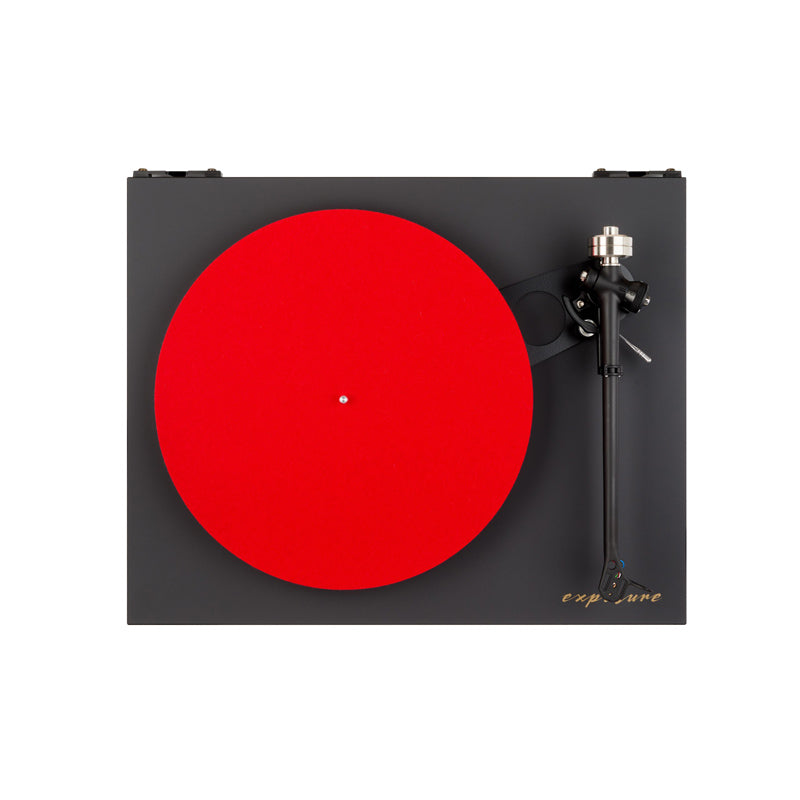
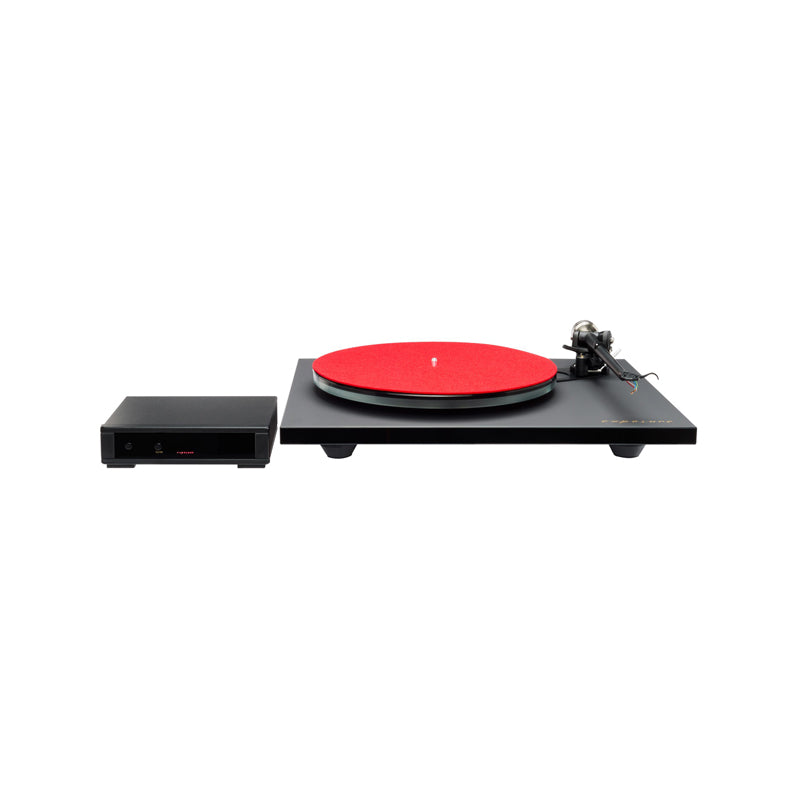
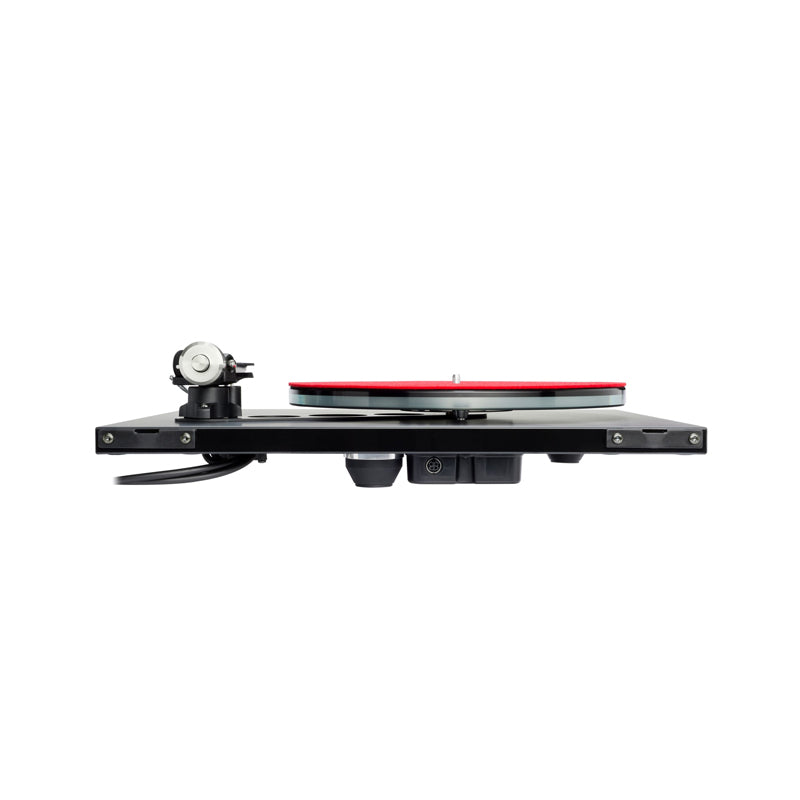
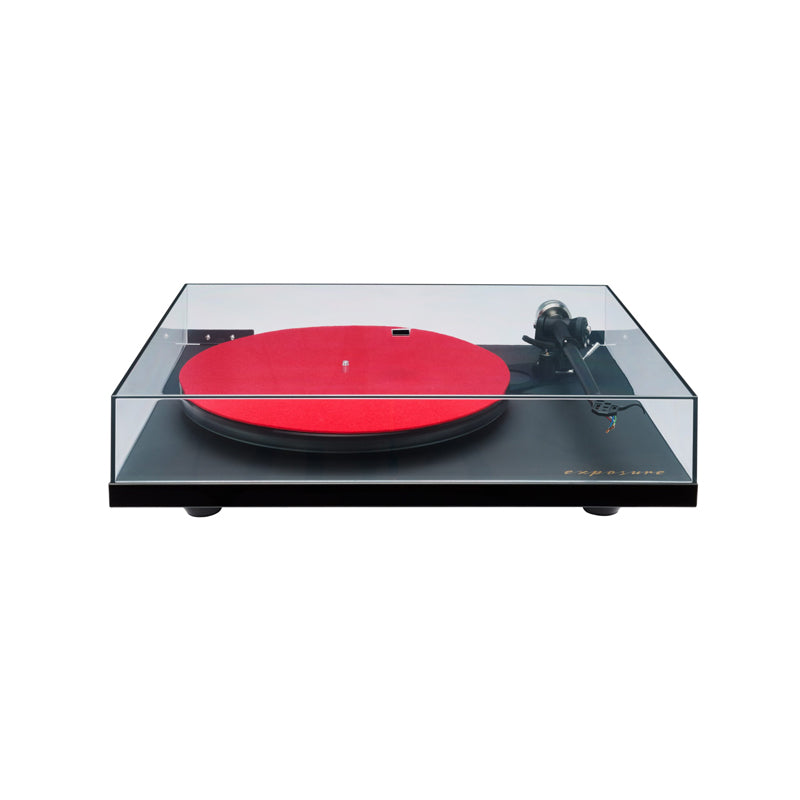
Six line-level inputs handle any source, and a single plug-in module slot lets you tailor the 5510 without paying for features you don't need: choose a moving magnet or moving coil phono board for vinyl, a DAC board with USB (up to 32-bit/768 kHz plus DSD) and BNC or optical inputs for digital — or, rare in the industry, a board for DS Audio's optical cartridges. Tape loop, dual preamp outputs, and bi-wiring-friendly twin 4 mm speaker terminals complete a connection set built for real systems. Fit the phono board and add the Exposure 360 turntable, and you have a single-brand vinyl front end voiced by the same engineers, end to end.
Why You'll Love the Exposure 5510
- Flagship engineering — the most advanced integrated amplifier Exposure has ever built
- 120 W per channel — Class AB power with genuine grip into demanding, low-impedance speakers
- Stepped-resistor volume control — high-end attenuation, precise across a ~95 dB range
- DC-coupled output stage — monoblock-derived topology, fewer capacitors in the signal path
- Modular upgrades — optional MM, MC, or DS optical phono boards, or hi-res DAC board
- OLED display — readable across the room, dimmable, auto-off for dark-room listening
- Purist build — custom shielded toroidal transformer, aluminium chassis, remote included
- Hand-built in Britain — 3-year warranty from a brand making amplifiers since 1974
Frequently Asked Questions
What's the difference between the Exposure 3510 and 5510 integrated amplifiers?
The 5510 steps up to 120 W per channel (from 110 W) with noticeably more drive into low-impedance speakers, adds the stepped-resistor volume control and OLED display, and adopts the DC-coupled output topology from Exposure's monoblocks. The 3510 remains superb value; the 5510 is the no-compromise statement.
Does the Exposure 5510 have a phono stage or DAC built in?
Out of the box it's a pure analogue line-level amplifier — by design. A single module slot accepts an optional MM, MC, or DS Audio optical phono board, or a DAC board with USB, BNC and optical inputs supporting up to 32-bit/768 kHz and DSD. You pay only for the functionality your system needs.
Does the 5510 have a headphone output?
No — Exposure kept the flagship purist, dedicating the entire design budget to loudspeaker amplification. If headphone listening matters to you, ask us about dedicated headphone amplifiers to partner it.
What speakers pair well with the Exposure 5510?
With 120 W per channel and strong low-impedance drive, it partners confidently with virtually any quality loudspeaker — from compact stand-mounts like the Guru range to full-size floorstanders. Its refined, slightly warm balance makes it an especially good match for revealing speakers.
Exposure 5510 Technical Specifications
| Type | Integrated stereo amplifier, Class AB |
| Power output | 120 W per channel into 8 ohms (1 kHz) |
| Output stage | DC-coupled with DC servo; four Toshiba transistors per channel |
| Volume control | Stepped resistor-ladder attenuator, ~95 dB range |
| Frequency response | 20 Hz – 20 kHz, ±0.5 dB |
| Signal-to-noise ratio | >100 dB (A-weighted, 1 kHz) |
| Channel separation | >60 dB @ 20 kHz |
| Total harmonic distortion | <0.02% (rated power, 8 ohms, 1 kHz) |
| Inputs | 6 × line-level (RCA); 1 module slot (optional MM / MC / DS phono or DAC board) |
| Outputs | Tape output, 2 × preamp outputs, dual 4 mm speaker terminals (bi-wire friendly) |
| DAC board (optional) | USB up to 32-bit/768 kHz + DSD; BNC or optical input |
| Display | OLED, 5 brightness levels, auto-off |
| Transformer | Custom toroidal with hum shield |
| Chassis | High-grade aluminium |
| Power consumption | <400 W (8 ohms, both channels driven) |
| Dimensions (W × H × D) | 440 × 115 × 300 mm |
| Weight | 12 kg net |
| Finish | Black; remote control included |
| Warranty | 3 years |
| Brand | Exposure Electronics, Britain — est. 1974 |